


Living Room Ceiling Beam Ideas for a Cozy, Elevated Look
Quick answer: Living room ceiling beams add warmth, texture and a focal point to a plain ceiling. Pick a style that matches your room (hand-hewn for rustic, smooth for modern, metal-look for industrial), size the beams to your ceiling height, and plan the layout around your lighting, fireplace and furniture. Faux wood beams are decorative, not structural, so follow the manufacturer's instructions for any product you choose.
A flat white ceiling leaves a living room feeling unfinished. Living room ceiling beams fix that. They add warmth, architectural character, texture and visual depth, and they pull the eye up and across the room. You can go rustic with exposed, hand-hewn timbers or keep it clean with smooth faux wood in a modern space. This guide covers styles, layouts, high and low ceilings, coffered alternatives, fireplaces, lighting and open-plan homes, plus the questions people ask most.
Why Living Room Ceiling Beams Make a Difference
Well-planned beams do more than decorate. They can:
- Add interest to a plain ceiling: Lines and shadow replace a blank surface.
- Create a warm, inviting feel: Wood tones soften hard edges and echo flooring and furniture.
- Establish a focal point: A beam run or grid gives the room a center of gravity.
- Emphasize high or vaulted ceilings: Beams show off height and pitch.
- Define zones in an open layout: Beams can mark the seating area without walls.
- Add texture and depth: Grain, hand-hewn marks or a metal-look finish give the ceiling a tactile layer.
Room proportions, ceiling height and beam placement all shape the result. Our post on how faux wood ceiling beams add warmth to modern interiors shows how one material can serve several styles. For a first overview of materials and sizes, start with the faux beams for ceilings buying guide.
Living Room Ceiling Beam Ideas for Every Interior Style
Rustic and Farmhouse Living Rooms
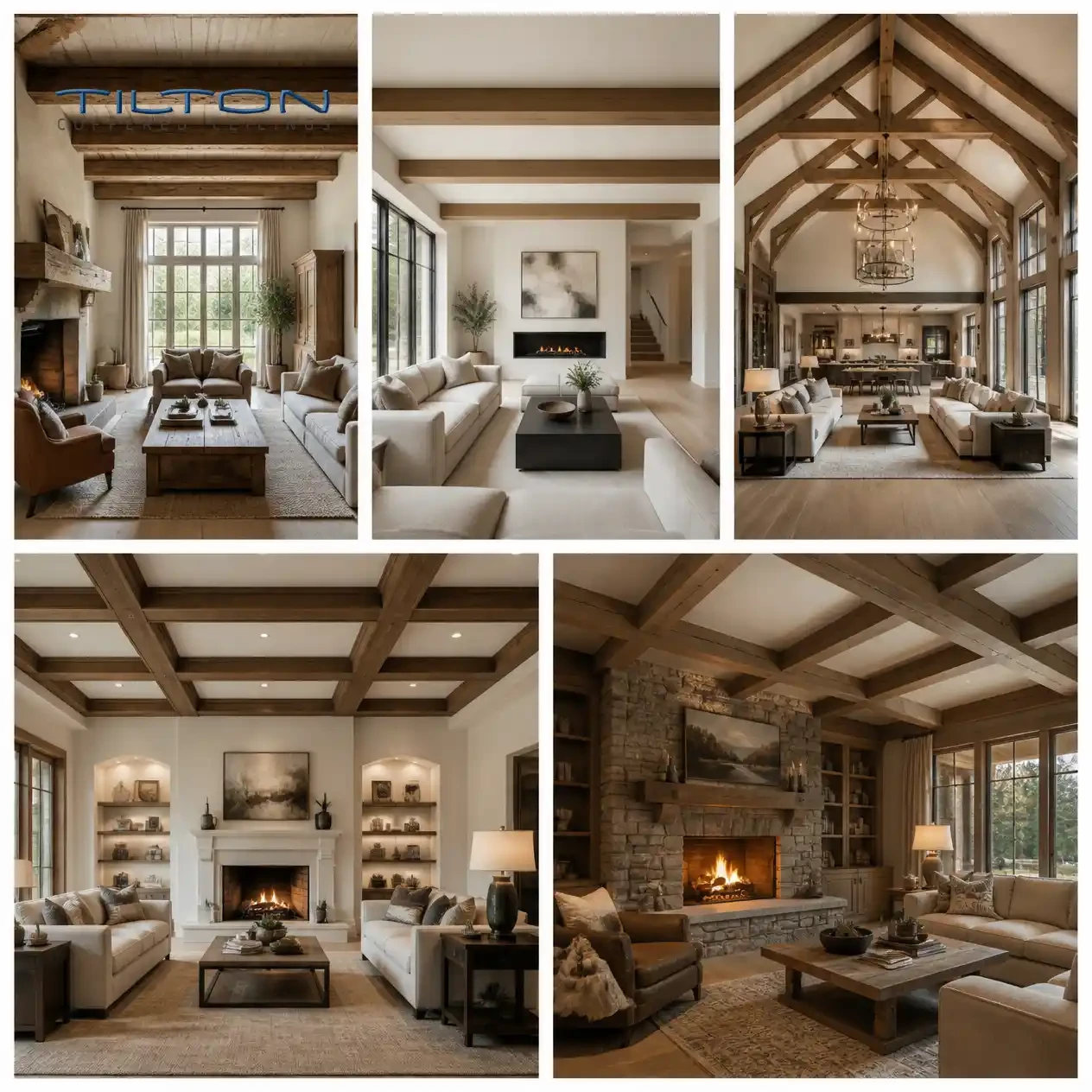
Rustic living room ceiling beams in warm stains, with visible grain and hand-hewn texture, suit farmhouse living rooms. Searches such as "rustic ceiling beams" and "faux hand hewn beams" show people want exactly this look. Pair the beams with linen or leather seating, a wood coffee table and natural stone. A hand-hewn texture reads best when the room has other natural materials to echo it.
Modern and Contemporary Living Rooms
Modern living room ceiling beams should stay restrained. A few evenly spaced beams in a smooth finish add contrast without crowding a minimalist room. Choose one lead element, either the beams or the fireplace wall, and let the rest stay quiet.
Traditional Living Rooms
Living room ceiling beams suit traditional rooms with crown molding, paneled walls and a classic fireplace. A simple grid or box beam ceiling pattern works well. Keep spacing even and finishes warm so the beams support the architecture instead of competing with it.
Transitional Living Rooms
Transitional rooms blend traditional warmth with modern simplicity. Transitional living room ceiling beams in a medium-tone smooth finish and a simple parallel layout work as a bridge. Match the beam tone to the flooring or the furniture legs so the ceiling feels connected to the room.
Industrial-Style Living Rooms
Industrial ceiling beams use darker, metal-look finishes for contrast against brick, concrete or painted walls. Searches for "faux steel beams" show interest in this look. Black or charcoal faux iron beams over a neutral sofa and wood floors give a loft feel without heavy construction.
Different Types of Faux Wood Ceiling Beams
Faux wood beams for ceiling projects are decorative shells made to look like timber. Tilton describes its faux beams as hollow and made from HDU polyurethane, which keeps them lightweight and lets them mount over wood blocking strips instead of structural work. They are decorative only and do not carry load.
Molded Faux Beams
Molded beams carry a textured, wood-inspired surface. Tilton's Molded Series is described as variable in thickness, which gives it a sculpted look. Texture is what keeps a stained beam from reading flat, especially under recessed lights.
Hand-Hewn Faux Beams
Hand-hewn beams suit farmhouse, lodge-inspired and traditional rooms. Tilton's Artisan Series has a hand-hewn texture and a consistent 1-inch thickness. If you are weighing textures, our comparison of Artisan Smooth and Artisan Series beams shows the difference.
Smooth Faux Beams
A smooth finish reads cleaner and suits modern and transitional living rooms. It pairs well with simple recessed lighting and quiet wall color.
Natural Wood Beam Series
Real wood has authentic grain and a solid feel. Tilton offers Natural Series real wood beams. Confirm weight, handling and installation needs with the manufacturer, and read our faux vs. real wood ceiling beams comparison for the trade-offs. Many shoppers search "real wood beams for ceiling" before they compare.
Industrial Ceiling Beams and Faux Iron Beams
Tilton's Industrial Series faux steel beams give a metal look, and the faux steel beams, panels and hardware guide covers the straps and hardware that finish it. Confirm size and construction for the exact product before you plan around it.
Living Room Ceiling Beams for High and Vaulted Ceilings
On a tall ceiling, living room ceiling beams emphasize vertical space and give a large living room visual structure. People search "faux beams for vaulted ceiling" and "faux wood beams for vaulted ceiling" often, so this is a common project.
- Follow the pitch: Beams that follow the slope emphasize the roofline.
- Run horizontal beams across the room: They break up a tall wall of drywall and add rhythm.
- Add a single focal beam: One beam at the peak can give a bare vault a center.
- Use faux wood trusses: A faux wood truss adds a framed, architectural look. Faux trusses and vaulted ceiling trusses suit great rooms with open sightlines.
Two classic truss designs are the king post truss, with a central vertical post, and the scissor truss ceiling, with crossing diagonal members. Decorative trusses are not structural trusses and do not carry roof load. See our truss ceiling ideas for vaulted ceilings, the decorative ceiling trusses style guide, the scissor truss vs. king post truss comparison and why ceiling trusses suit great rooms.
Low Ceiling Beam Ideas for Living Rooms
Living room ceiling beams can work on a lower ceiling when they are sized for the room. People search for "low profile faux ceiling beams" because depth is the main worry.
- Choose proportionate dimensions: Pick the shallowest beam that still looks right. Our post on custom-fit shallow beam kits covers shallow-profile options.
- Avoid heavy designs: Use fewer, lighter beams with generous spacing rather than many deep ones.
- Think about finish: A light or ceiling-matched tone keeps beams from feeling heavy.
- Balance the layout: Parallel beams across the narrow direction usually look calm.
- Coordinate with lighting: Plan beam depth and fixture position together.
- Keep clearances: Check height near doors, light fixtures and fans.
We do not give a universal beam size or minimum ceiling height. Your room, your local code and the product decide. Our how-to-measure diagrams show where to measure.
Living Room Coffered Ceilings vs. Decorative Ceiling Beams
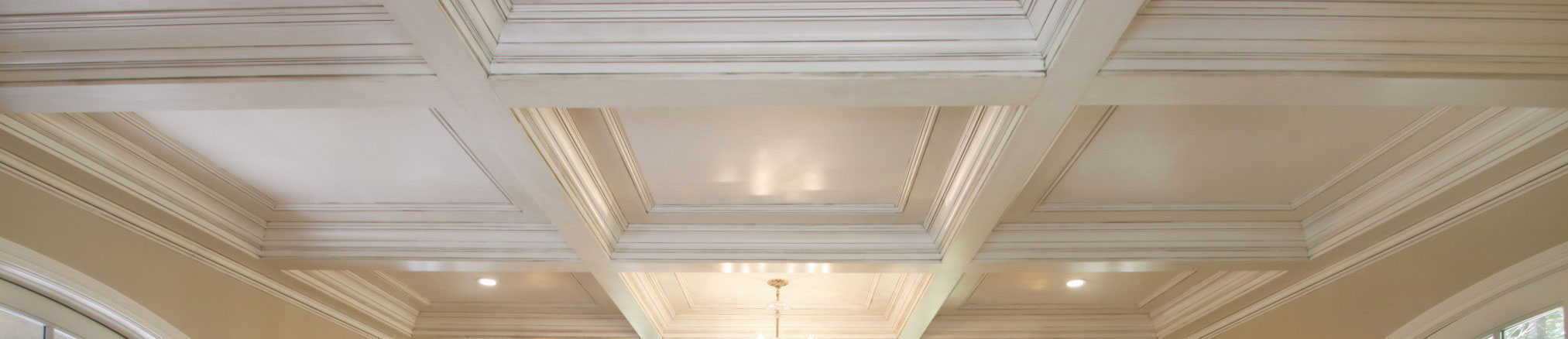
A coffer is, in architectural terms, one of a series of sunken panels in a ceiling, soffit or vault. A living room coffered ceiling builds a grid of recessed panels. Decorative beams create linear patterns and accents, and can also form a grid.
|
Factor |
Coffered ceiling |
Decorative ceiling beams |
|
Look |
Structured, grid-like, formal |
Linear, relaxed, warm |
|
Character |
Classic and architectural |
Rustic to modern depending on finish |
|
Flexibility |
Pattern tied to the grid |
Spacing and direction easy to vary |
|
Best styles |
Traditional, transitional |
Rustic, farmhouse, modern, industrial |
|
Complexity |
More planning and layout |
Simpler runs are easier |
|
Proportion note |
Needs a regular room shape |
Works in many ceiling shapes |
Many readers search "coffered ceiling ideas," "wood coffered ceiling" and "shallow coffered ceiling," which shows demand for a lower-profile grid. Learn the basics in our coffered ceiling guide and see how coffered ceilings transform flat ceilings. Browse coffered ceiling panels and kits if you want a grid. Shoppers often search "coffered ceiling kits" for this. You can also combine the two, with a coffered grid and beam details for emphasis.
How to Coordinate Ceiling Beams with Fireplaces, Furniture and Lighting
Fireplace. Living room ceiling beams with a fireplace work best when you match or deliberately contrast the beam finish with the surround. A faux fireplace mantel or a DIY fireplace mantel in a coordinating tone ties the ceiling to the hearth. People often search "faux wood mantel" while planning this. Tilton sells faux wood mantels as a separate product. Do not use a ceiling beam as a mantel unless the manufacturer confirms that use and its safety requirements.
Furniture and flooring: Echo the beam tone in wood flooring, tables or shelving. A contrasting beam over a warm floor adds depth.
Wall colors: Pale walls let dark beams stand out. Warm neutral walls soften medium-tone beams.
Lighting: Recessed lights between beams avoid heavy shadows. Pendants and chandeliers should hang from approved fixtures, not decorative beams, unless the installation instructions allow it. Natural light changes how stain reads, so view a sample at several times of day. You can order beam samples and check the colors and textures page.
Living Room Ceiling Beams in Open-Concept Homes
When a living room flows into a kitchen or dining area, consistent living room ceiling beams help connect the spaces. Repeat the finish, keep spacing and direction consistent, and let sightlines run through. Kitchen island beams are one related example of beam placement in a connected kitchen. For a cleaner division, change the beam direction at the zone edge. Our tongue and groove ceiling guide and ceiling and wall planks offer complementary finishes, and decorative wall panels and floating ceiling panels are other treatments to compare.
How to Choose the Right Living Room Ceiling Beam Design
Choosing living room ceiling beams is easier in this order:
- Style: Match the beam finish to your overall look.
- Ceiling height and room size: Measure first, then choose depth and width.
- Beam size and proportion: Scale to the room, not the catalog.
- Finish and texture: Order samples before you commit.
- Layout and spacing: Sketch the plan on paper.
- Lighting: Plan natural and artificial light together.
- Existing features: Note fireplaces, windows, vents and soffits.
- Adjacent rooms: Keep finishes consistent in open plans.
Use the compare page and product options to narrow choices, or see finished work in the gallery.
Installation and Maintenance Considerations
There is no single method for every product, so start with the manufacturer's instructions.
- Read the installation resources that come with your beams.
- Check the ceiling substrate and confirm approved mounting methods.
- Use the hardware the product specifies. Tilton's installation products are one place to look. Tilton's buying guide describes mounting wood blocking strips to the joists and sliding the hollow beam over them, but confirm the method for your beam.
- Keep access to wiring and other building systems.
- Plan beam placement around light fixtures.
- Follow product-specific maintenance guidance.
- Hire a qualified installer when the job calls for one.
We do not list load capacities, fasteners or warranty terms here, because they depend on the product.
Create a Cozy, Elevated Living Room with the Right Ceiling Beams
The right living room ceiling beams come down to five choices: style, depth, finish, layout and installation method. Match the style to your room, scale the beams to your ceiling, coordinate them with the fireplace and lighting, and follow the manufacturer's instructions. Explore Tilton's ceiling beams and trusses and get a quote, browse the FAQs, or contact the team.
Frequently Asked Questions About Living Room Ceiling Beams
1. What are the benefits of living room ceiling beams?
Living room ceiling beams add warmth, texture and a focal point, emphasize high ceilings and define zones in open layouts. They also tie the ceiling to flooring, furniture and the fireplace.
2. Are faux wood beams a good choice for living rooms?
Often yes. Tilton describes its faux beams as hollow and lightweight, with wood-look finishes and textures. They are decorative, so confirm product details before you buy.
3. Which ceiling beams work best in a modern living room?
Smooth faux beams in a restrained layout work well for modern living room ceiling beams. Use even spacing, a quiet finish and one lead feature.
4. Can ceiling beams make a living room feel cozier?
Yes. Warm tones, texture and a defined layout make a large ceiling feel more enclosed and inviting.
5. Are decorative beams suitable for low ceilings?
They can be, if sized carefully. Choose shallow beams, use fewer of them and keep light finishes. Measure first and check local requirements.
6. What is the difference between faux wood beams and natural wood beams?
Natural wood has real grain, while faux beams are decorative shells made to look like wood. Tilton describes its faux beams as hollow and lightweight. Check weight, handling and installation requirements for each product.
7. Can ceiling beams be used with a vaulted ceiling?
Yes. Beams can follow the pitch, run horizontally or form a faux wood truss. Decorative trusses do not carry structural load.
8. What is the difference between a coffered ceiling and decorative ceiling beams?
A coffered ceiling is a grid of recessed panels. Decorative beams form linear patterns and can also make a grid. Coffers feel more formal, and beams feel more relaxed.
-800x800.png "Custom Fit Shallow Beam")
-800x800.png "Faux Wood Ceiling Beams")
-800x800.png "Ceiling Trusses")