


Faux Wood Mantels: Styles, Sizing & Installation Guide
Quick answer: Faux wood mantels are wood-look fireplace mantels made from a material other than solid timber, such as hollow high-density polyurethane. They give a fireplace the look of a heavy beam without the weight. Before you buy, check four things: the style, the size relative to your firebox, how the mantel mounts to the wall, and the fireplace clearances in your manufacturer's instructions and local code.
A mantel is the first thing your eye lands on in a living room. It frames the fireplace, anchors the wall and sets the style for everything around it. Solid timber is heavy, expensive to ship and demanding to mount. That is why many homeowners, designers and builders now look at faux wood mantels. This guide explains how they work, how to pick a style, how to size one, how to install one and what to check for fireplace safety. It also shows how a mantel fits with the ceiling beams and trusses and wall paneling around it.
What Are Faux Wood Mantels?
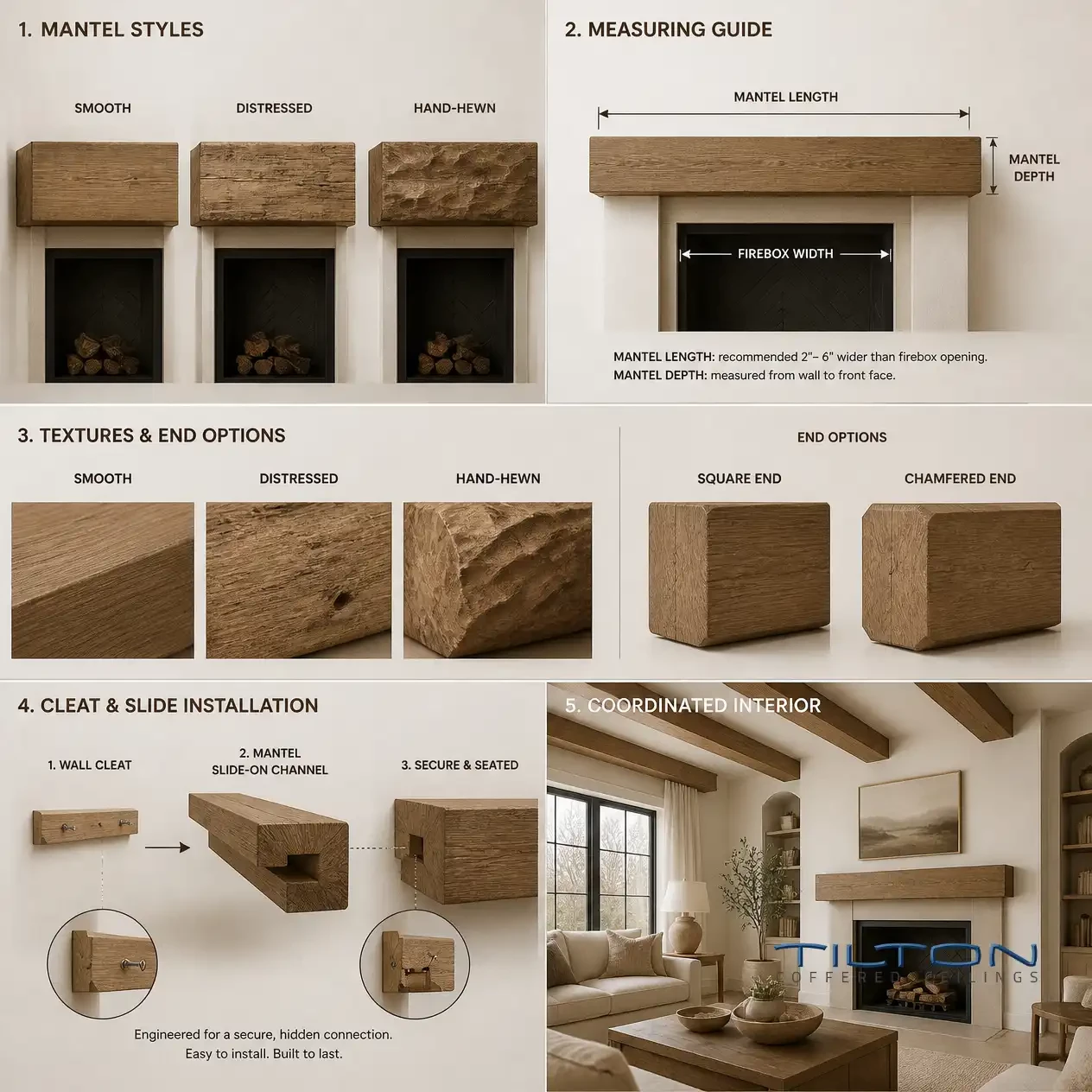
A faux wood mantel is a decorative mantel shelf or beam that imitates the look of timber. Tilton Coffered Ceilings lists its faux wood beam mantels as hollow, high-density polyurethane pieces, offered in standard and custom lengths. They can be stained to match flooring and cabinetry, and come in smooth, distressed and hand-hewn textures with square or chamfered ends.
A few points about the term:
- "Faux" describes the material, not the look: A good faux mantel reproduces grain, knots and texture. It is not solid wood, so it behaves differently when you cut, mount and clean it.
- Finish names are not material specs: "Distressed" or "reclaimed-look" tells you how it looks. It does not tell you what it is made of or how it handles heat. Always read the manufacturer's specifications.
- A beam mantel is a different thing from a ceiling beam: Do not assume a ceiling beam can double as a mantel. Confirm the application with the maker first.
For a deeper look at the material itself, read our faux beams for ceilings buying guide and the comparison of faux wood vs real wood ceiling beams.
Popular Faux Wood Mantel Styles
Style is a design choice, not a rule. These are the common directions, and which interiors they tend to suit.
Rustic and farmhouse
Hand-hewn texture, visible grain and warm stains suit farmhouse, cabin and lodge rooms. Pair them with stone or brick surrounds and natural fabrics. Tilton's Artisan Series shows what a hand-hewn texture looks like on a beam.
Smooth and contemporary
A smooth, clean-lined mantel works in modern and transitional rooms. A squared profile and a stain close to your flooring keeps the look calm. See how smooth beams compare with textured ones.
Distressed and reclaimed-look
Distressing adds age and character. It works well against plaster, painted brick and simple walls, where the mantel is the main texture in the room.
Traditional and classic
Chamfered ends and a deeper profile read as more formal. They suit traditional and colonial interiors, especially with wainscoting and trim.
Minimalist mantel shelves
A single plain beam over a flat wall suits minimalist rooms. It is the simplest style to match with other finishes.
Mantels coordinated with decorative wood beams
When the room has ceiling beams, match the stain and texture on the mantel. The Molded Series and Natural Series real wood beams show the range of looks available overhead. For warmth in a modern room, see how faux wood beams add warmth.
How to Choose the Right Faux Wood Mantel Size
There is no single correct size. Proportion depends on the fireplace, the wall and the room.
- Fireplace and surround width: Measure the firebox opening and the full surround. Tilton's category page advises scaling the mantel to the firebox width and extending slightly past the opening. That is a design guideline, not a code requirement.
- Length: A longer mantel looks balanced on a wide chimney breast. A short one can look lost. Look at the whole wall, not just the fireplace.
- Depth and projection: Depth controls how much the mantel sticks out. A deeper mantel gives you more shelf space and more visual weight, but it also affects clearances and traffic in the room.
- Wall space and ceiling height: In a room with a high ceiling, a taller chimney breast can carry a heavier mantel. In a low room, a slimmer profile keeps the wall from feeling crowded. For low ceilings, the same logic applies to beams, as in our guide to shallow beam kits.
- Surrounding furniture and décor: Think about what will sit on the mantel and what hangs above it, such as a mirror or a television.
- Mounting location and support: The wall behind the mantel must hold the mounting system. Know where the studs are before you decide on a position. Use Tilton's measuring diagrams as a template for taking measurements.
- Clearance requirements: This is the one that cannot be decided by looks. See the safety section below.
Faux Wood Mantel Materials, Finishes and Appearance
When you compare finishes, look at four things:
- Texture: smooth, distressed or hand-hewn. Texture changes how light falls on the mantel.
- Color: a stain that matches your floor or cabinets looks planned. Compare against the actual stain options in the textures and colors gallery.
- End style: square ends look modern and crisp. Chamfered ends look more traditional.
- Sample first: a photo can mislead. Order a sample and look at it next to your wall color, floor and firebox in the room's actual light.
Finish descriptions tell you about appearance only. They do not establish what a product is made of, how it handles heat or how it should be cleaned. Ask for the specification sheet.
How to Install a Faux Wood Mantel
The exact steps depend on the product, the wall and the fireplace. Treat this as an overview and follow the manufacturer's instructions.
- Confirm suitability: Check that the product is intended for your location and fireplace type.
- Measure: Mark the fireplace opening, the wall width and the proposed mantel height.
- Check clearances: Compare your planned position with your fireplace manufacturer's instructions and local code.
- Find the wall structure: Locate studs or other solid framing. Tilton's category page notes that you should confirm stud locations before mounting.
- Mount as instructed: Tilton describes a cleat secured to the wall framing, with the hollow mantel sliding over it and being fastened. Brick, stone and tile surfaces need a suitable mounting system anchored into the structure.
- Check alignment: Use a long level before you fasten, and check the mantel against the firebox opening.
- Finish and inspect: Touch up any marks and confirm the mantel is secure.
Tilton's page says a DIY project can take just a few hours, but that depends on your wall and tools. If the wall is masonry, the fireplace is gas or wood-burning, or you are unsure about the framing, hire a qualified installer. The full guides are in how to install, and the beam installation products and accessories pages list the hardware.
Faux Wood Mantels and Fireplace Safety
A mantel sits near heat. Decorative appearance alone does not establish heat resistance or fire safety, so verify the product for the exact fireplace before you install it.
- Heat sources: Wood-burning fireplaces, gas fireplaces and inserts all radiate heat differently.
- Manufacturer instructions: For manufactured fireplaces and inserts, the listing and the manufacturer's instructions govern.
- Building and fire codes: For masonry fireplaces, the International Residential Code limits combustible trim near the opening. Per this Journal of Light Construction summary of the IRC, no exposed combustible mantel or trim is allowed within 6 inches of the opening, and between 6 and 12 inches only thin trim is allowed. Local code versions can differ.
- Support: The mantel must be mounted and supported correctly.
Tilton's category page gives no clearance distances or fire rating for its mantels. Confirm any rating or heat limit with Tilton before installing above a working firebox, and do not assume one.
Faux Wood Mantels vs. Real Wood Mantels
|
Factor |
Faux wood mantel |
Real wood mantel |
|
Appearance |
Depends on the material and finish |
Shows the natural characteristics of the selected wood |
|
Texture and variation |
Depends on the manufacturing and finishing process |
Varies naturally with species and grain |
|
Weight |
Must be confirmed for the specific product |
Depends on species, dimensions and construction |
|
Maintenance |
Follow the manufacturer's care instructions |
Depends on wood species and finish |
|
Cost |
Varies by product and supplier |
Varies by species, dimensions and craftsmanship |
|
Installation |
Depends on the mounting system and wall |
Depends on dimensions, weight and mounting requirements |
|
Heat suitability |
Must be confirmed for the specific product |
Must be assessed for the material, finish and fireplace requirements |
Neither option is always cheaper, lighter or easier. The right choice comes from the product specification and your fireplace. For the beam version of this comparison, see faux vs real wood ceiling beams.
How to Coordinate a Faux Wood Mantel With Your Interior Design
A mantel looks best when it repeats something already in the room.
- Fireplace surround and wall finish: Warm stains look good against stone and white plaster. Darker stains need a lighter wall.
- Floors, furniture and cabinets: Match the undertone, not necessarily the exact color.
- Ceiling beams: Repeat the stain and texture overhead. Browse the ceiling beams and decorative trusses, or read about decorative ceiling trusses and truss pattern choices for vaulted ceilings.
- Ceiling planks: A tongue and groove ceiling in a similar tone ties the room together. See real wood ceiling and wall planks.
- Wall panels: Decorative wall panels can frame the chimney breast.
- Coffered ceilings: A coffered ceiling works with a classic mantel. See how coffered ceilings transform flat ceilings.
- Great rooms: In large rooms, ceiling trusses and a substantial mantel can share the focus.
Common Faux Wood Mantel Selection and Installation Mistakes
- Choosing a size without looking at the surround: Measure the firebox and the whole wall first.
- Picking a finish that fights the room: Test a sample in your light.
- Assuming every faux wood product suits a fireplace: Many do not. Check the specification.
- Ignoring mounting and support: A hollow mantel still needs solid framing or a proper anchor system.
- Skipping the manufacturer's instructions and clearances: These are the rules for your unit.
- Treating a decorative beam or shelf as a mantel: Confirm the application with the maker.
- Forgetting upkeep: Ask how to clean and care for the finish.
How to Choose the Right Faux Wood Mantel for Your Home
Use this checklist:
- Style: rustic, smooth, distressed, traditional or minimalist.
- Size: length, depth and projection that suit the firebox and wall.
- Finish: a stain and texture that matches the room. Order a sample.
- Documentation: the specification sheet, including weight and heat guidance.
- Fireplace compatibility: wood-burning, gas or insert, and the maker's clearances.
- Mounting: studs, masonry or tile, and the right hardware.
- Maintenance: how to clean it and what to avoid.
- Budget: compare quotes. Use the quote tool or contact the team for custom lengths.
Browse the faux wood beam mantels, the gallery of beams and trusses and the FAQs when you are ready to compare.
Final Thoughts
Faux wood mantels give a fireplace the look of a heavy timber beam, and they are easier to handle than solid wood. The best choice comes from matching the style to the room, sizing the mantel to the firebox and wall, checking the mounting and, above all, confirming the clearances and heat guidance for your own fireplace.
When you are ready, explore the faux wood beam mantels, the ceiling beams and trusses and the ceiling and wall planks to build a fireplace wall and ceiling that work together.
Keep Reading
Beam series: Industrial Series | Commercial coffered beam ceilings
Planks and panels: Floating ceiling panels
Trusses and ceilings: Scissor vs. king post truss | Faux steel beams and panels | Product options | Compare products
Frequently Asked Questions
1. What is a faux wood mantel?
A faux wood mantel is a decorative fireplace mantel that imitates timber using a material other than solid wood. Tilton's faux wood beam mantels are hollow high-density polyurethane, with smooth, distressed and hand-hewn textures, and can be stained to match your room.
2. How do I choose the right size faux wood mantel?
Start with the fireplace and surround width, then consider the wall, ceiling height and the projection you want. A common design approach is to scale the mantel to the firebox and extend it slightly past the opening, but check clearances before you decide.
3. Are faux wood mantels suitable above a working fireplace?
It depends on the product and the fireplace. Appearance does not establish heat resistance, so confirm suitability with the manufacturer's documentation, your fireplace instructions and local code before you install one above a working fireplace.
4. How do you install a faux wood mantel shelf?
Confirm where the studs are, secure a cleat to the wall framing, slide the hollow mantel over it, fasten it and check it with a level. The exact method depends on the product and the wall, so follow the manufacturer's instructions.
5. What is the difference between faux wood and real wood mantels?
A real wood mantel shows the natural grain of its species, while a faux wood mantel imitates it using another material. Weight, cost, upkeep and heat suitability vary by product, so compare the specifications for each.
6. How do you maintain a faux wood mantel?
Follow the manufacturer's care instructions, because cleaning needs depend on the material and finish. Ask for the care guidance before you buy.
7. Can a faux wood mantel complement decorative ceiling beams?
Yes. Matching the stain and texture of the mantel to your ceiling beams helps the fireplace wall and ceiling look planned. Tilton lists faux wood beam mantels next to its ceiling beams so you can compare finishes.
8. What should I check before buying a faux wood mantel?
Check the material, weight, finish, mounting method and heat guidance in the product specification. Also check your fireplace type, the manufacturer's clearances and local code.
-800x800.png "Custom Fit Shallow Beam")
-800x800.png "Faux Wood Ceiling Beams")
-800x800.png "Ceiling Trusses")