


Scissor Truss vs. King Post Truss: Decorative Options Compared
Content Outline
Scissor Truss vs. King Post Truss: Decorative Options Compared
- Quick Answers
- What Are Decorative Trusses?
- What Is a Scissor Truss?
- What Is a King Post Truss?
- Scissor Truss vs. King Post Truss: Key Differences (table)
- Which Decorative Truss Style Is Best for Your Ceiling? (+ other styles)
- Decorative Trusses, Faux Wood Trusses, and Decorative Ceiling Beams
- How to Coordinate Trusses With Other Ceiling Finishes
- Common Mistakes to Avoid
- How to Select Decorative Trusses for Your Project
- Final Thoughts
- FAQ
A scissor truss has sloping bottom chords that cross and rise with the roof, so it opens up a vaulted ceiling. A king post truss has a central vertical post and a flat bottom line, so it creates a symmetrical, traditional focal point. That one difference shapes how a room feels, which is why the choice between these two decorative truss styles matters more than most homeowners expect. This guide compares them side by side, shows where each one fits, and explains how faux wood versions work as a decorative option.
Scissor Truss vs. King Post Truss
- Decorative truss styles at a glance: the two most-compared options are the scissor and the king post.
- Main difference: a scissor truss crosses its lower chords and emphasizes ceiling slope and height. A king post truss centers on one vertical post and emphasizes symmetry.
- Best for a vaulted or cathedral ceiling: a scissor-inspired design usually echoes the slope. A king post design can still work as a single focal point.
- Best for a rustic, farmhouse, or timber-inspired room: king post profiles are the classic fit.
- Decorative or structural? Decorative trusses are visual. Do not assume any decorative product carries roof loads.
- Faux wood or beams? Faux wood trusses give the timber look in a lighter form, and decorative ceiling beams are simpler single accents.
What Are Decorative Trusses?
Decorative ceiling trusses are triangular or multi-member assemblies that copy the look of exposed timber roof framing. Designers use decorative truss styles to add architecture to a flat or vaulted ceiling. They draw the eye upward, define a zone such as a living area, and give a plain ceiling a clear focal point.
A real roof truss is an engineered structural frame that carries the roof. A decorative truss is a design element. Unless a qualified professional has specifically engineered and documented it for load, treat a decorative truss as non-load-bearing. Anything that touches the roof structure, ceiling framing, or load path needs a structural professional's review, not a product page's marketing copy.
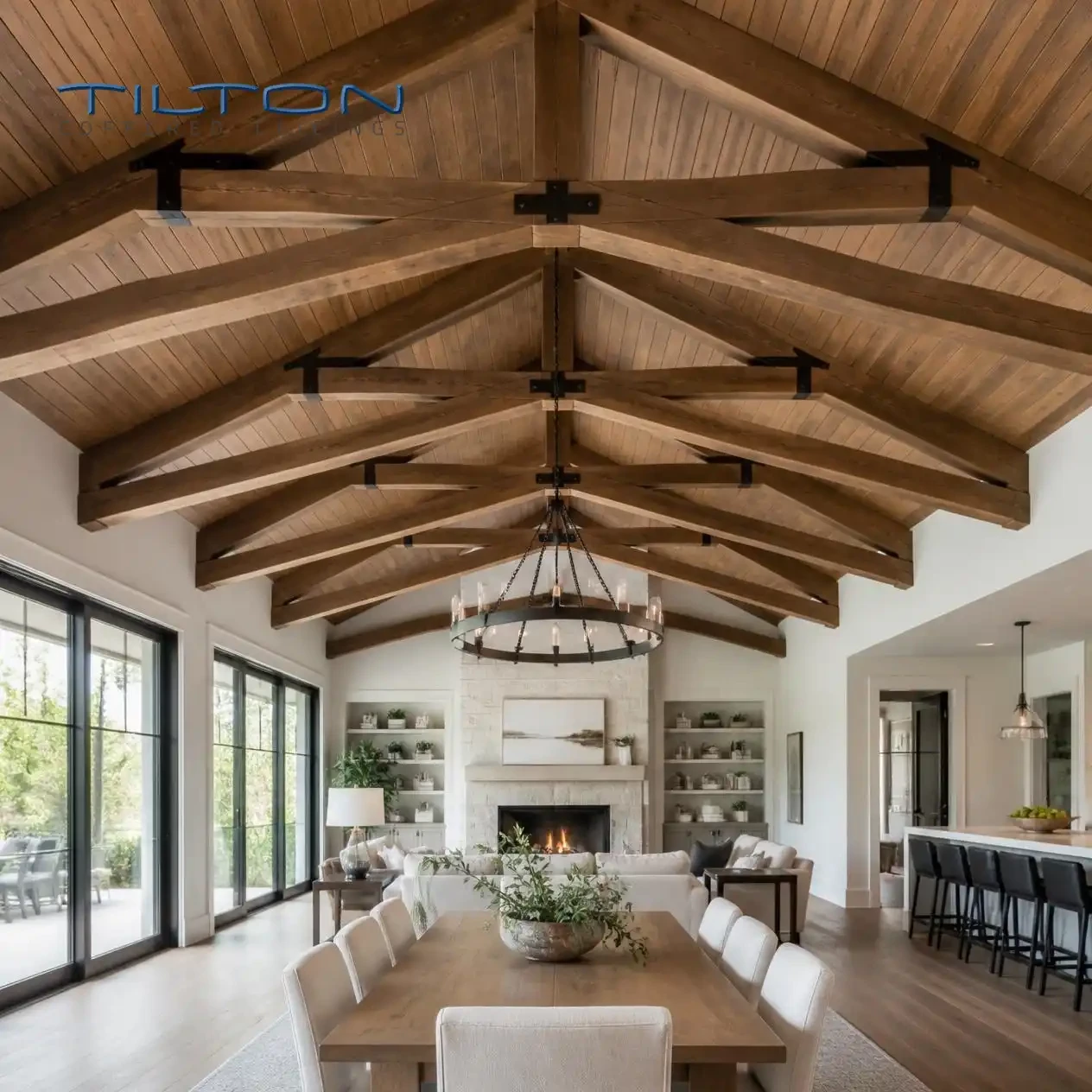
Tilton's ceiling truss category describes its faux wood beam trusses as lightweight, made to look like real timber, and made to order for the ceiling's size and slope. The page says they are built from HDU foam. Dimensions, finishes, and mounting requirements vary by product, so read each product page in full.
What Is a Scissor Truss?
A scissors truss has bottom chords that cross each other and join the angled top chords partway along their length, like an open pair of scissors. The result is a ceiling that slopes up from the walls instead of staying flat. In a structural roof this gives a sloped interior ceiling under a pitched roof. In a decorative design, the same silhouette is a way to emphasize height.
Visual shape and ceiling profile: The crossing lines create strong diagonals. They follow the slope of the room and lead the eye to the peak.
Interior design applications: Scissor-inspired designs suit great rooms, open-plan living spaces, and cathedral or vaulted ceilings, where the slope is already part of the architecture.
Advantages and design considerations:
- The diagonals reinforce a vaulted ceiling's height.
- The open center keeps the volume of the room visible.
- The crossing members create more visual activity, so scale, finish, and spacing matter.
- Sightlines and lighting need attention, because the diagonals interact with fans, pendants, and windows.
When the appearance suits a room: Choose it when you want the ceiling shape itself to be the feature, in transitional, contemporary, or modern-rustic interiors. Of all the decorative truss styles, it follows a slope most closely.
Decorative faux wood options: A faux wood version can recreate the timber look and crossing profile in a lighter assembly. Tilton lists its trusses by style number rather than by traditional names, so compare the photos and drawings on the truss category and ask Tilton to confirm which configuration matches the look you want.
What Is a King Post Truss?
A king post truss is a triangle built around one vertical member, the king post, which runs from the apex down to a horizontal tie beam. Rafters rise from each end of the tie beam to meet at the peak. Its symmetry and clear geometry make it one of the most recognized timber truss shapes.
Main visual characteristics: A triangular outline, a central vertical, and a flat bottom line. The flat tie beam reads as a strong horizontal across the room.
Interior design applications: It works as a single feature over a dining table, a living area, an entry, or a great room. Repeated at even intervals, it creates a rhythmic, formal ceiling.
Advantages and design considerations:
- The symmetry is easy to read and easy to align with a fireplace or table.
- The shape has a traditional, timber-framed character.
- The horizontal bottom line lowers the visual ceiling slightly, so room height and proportions matter.
- The vertical post can compete with a chandelier or pendant hung in the same spot.
When the style suits a room: Choose it for rustic, farmhouse, lodge, or traditional rooms where you want a clear focal point.
Decorative faux wood options: Faux wood construction can recreate the timber look and king post profile with a lighter assembly. As above, confirm the exact configuration with Tilton, since the catalog uses style numbers.
Scissor Truss vs. King Post Truss: Key Differences
|
Comparison factor |
Scissor truss |
King post truss |
|
General visual shape |
Sloping lower chords that create an angled ceiling profile |
Triangular arrangement with a central vertical king post |
|
Visual character |
Often suited to vaulted and contemporary or transitional interiors |
Often associated with traditional, rustic, farmhouse, and timber-inspired interiors |
|
Ceiling appearance |
Emphasizes the slope and height of a vaulted ceiling |
Emphasizes a triangular focal point and visual symmetry |
|
Decorative application |
Can complement exposed-beam and vaulted-ceiling designs |
Can create a distinctive decorative focal point |
|
Design considerations |
Ceiling pitch, room proportions, sightlines, and finish |
Room width, visual balance, truss proportions, and finish |
|
Material and finish |
Depends on the selected product or construction |
Depends on the selected product or construction |
|
Structural requirements |
Must be assessed separately by a qualified professional |
Must be assessed separately by a qualified professional |
These decorative truss styles differ in look, not in any promise of performance. The points above are design observations, not engineering rules. Suitability depends on the room, the design, the product, and the project.
Which Decorative Truss Style Is Best for Your Ceiling?
Work through these factors in order.
- Ceiling shape and pitch. A strongly pitched vault gives a scissor-inspired design something to follow. A lower or flatter ceiling often suits a simpler king post or a few beams. Our guide to choosing the right truss pattern for vaulted ceilings walks through pitch and ridge direction in detail.
- Room dimensions and proportions. A wide room can carry a larger truss or a repeated series. A narrow room usually needs fewer, slimmer elements.
- Architectural style. Rustic, farmhouse, and traditional rooms lean toward king post profiles. Contemporary and transitional rooms lean toward scissor-inspired lines.
- Existing beams and finishes. Match the truss to any decorative wood beams already in the room, or choose a deliberate contrast.
- Natural light and lighting. Plan fixtures, fans, and windows before you settle the layout. A king post's vertical needs clear space, and a scissor's diagonals need clear sightlines.
- Residential or commercial use. Restaurants, lodges, and tasting rooms often use trusses for atmosphere. Homes use them to define living areas.
- Budget and installation. Prices vary by product, size, finish, and installer, so ask for samples and a written quote. Read installation instructions before you buy.
When a scissor-inspired design fits: tall, sloped, open rooms where you want the ceiling to be the feature. When a king post design fits: rooms where you want a symmetrical, traditional focal point, or a repeated formal rhythm.
Not sure which? Mock both up with painter's tape or a quick sketch and step back to the main seating area.
Other Decorative Truss Styles Worth Knowing
King post and scissor are not the only options. Queen post (two vertical posts), arched, hammerbeam, and flat or horizontal-tie profiles are also popular. Our complete style guide to decorative ceiling trusses covers them all.
Decorative Trusses, Faux Wood Trusses, and Decorative Ceiling Beams
A truss is a framed assembly with a clear outline, such as a triangle. A beam is a single linear piece. The two are not interchangeable. A truss is a focal element, and a beam is a repeated or single accent. Neither should be treated as a substitute for structural framing.
- Faux wood trusses recreate timber framing in a lighter form. They suit vaulted rooms where a heavy real-timber look is wanted without the visual and handling weight.
- Faux beams for ceilings (also called ceiling faux beams, fake ceiling beams, or foam beams) run along a ceiling to add rhythm. They are simpler than a truss.
- Decorative wood beams can be real or faux wood. Compare them with our faux beams vs. real wood beams guide.
Beam series differ in texture and character, which helps you coordinate with a truss:
- Molded Series faux beams for cast-wood detail.
- Artisan Series hand hewn faux beams for rustic texture, and Artisan Smooth faux beams for a cleaner look.
- Natural Series real wood beams for genuine timber.
- Industrial Series faux steel beams, also called faux iron beams, for loft and industrial rooms. Pair them with decorative straps and bolt accents from the accessories category.
Match one texture family to the truss, and use the textures and colors page to compare finishes.
How to Coordinate Trusses With Other Ceiling Finishes
A truss gets stronger when the surfaces around it stay quiet.
- Tongue and groove ceiling planks: Planks between trusses add warmth and a wood-on-wood look. Keep the plank color lighter or similar so the truss stays the lead. Browse tongue and groove ceiling planks and other ceiling and wall paneling, and see our tongue and groove ceiling.
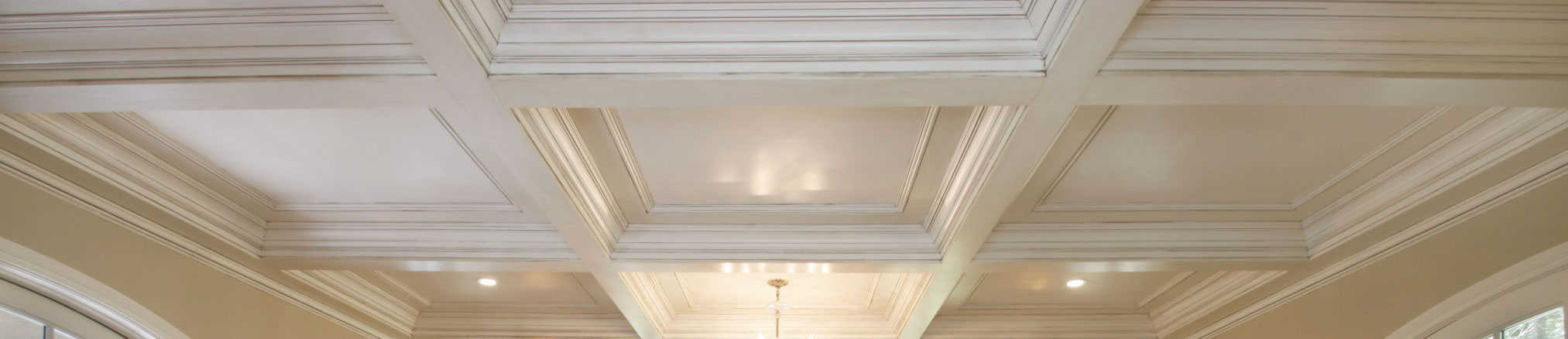
- Coffered ceiling panels: In a large open room, a coffered section can sit beside a truss zone. Don't layer both over the same area. Read what a wood coffered ceiling is.
- Decorative wall panels: Decorative wall panels can echo the truss finish on a gable or feature wall.
Only in specific cases:
- Floating ceiling panels and lightweight ceiling tiles can work in rooms that need acoustic or service access.
- Commercial ceiling panels and commercial coffered ceilings suit restaurants and offices.
- Faux metal ceiling tiles and decorative drop ceiling tiles fit an industrial look beside a steel-finish beam or truss.
Common Mistakes to Avoid When Choosing Decorative Truss Styles
- Ignoring room proportions: A large truss in a small room feels heavy.
- Mixing incompatible styles: A rustic king post over a sleek modern room reads as confused.
- Ignoring pitch and sightlines: Check the view from the main seating area before you commit.
- Overcrowding the ceiling: Too many beams, trusses, and panels compete.
- Choosing a finish that clashes: Test it against floors, cabinets, and trim.
- Overlooking lighting and installation access: Plan fixtures and access first.
- Confusing decorative with structural trusses: Decorative products are not roof framing.
- Assuming every faux truss suits every ceiling: Check each product's size, slope, and mounting details.
How to Select Decorative Trusses for Your Project
- Style: rustic, farmhouse, traditional, transitional, or modern
- Ceiling: pitch, ridge direction, height, and room dimensions
- Shape: scissor-inspired, king post, or another of the decorative truss styles
- Finish: compared under your own light with a sample
- Scale and spacing: sketched or taped up first
- Other features: lights, fans, vents, and skylights marked on your plan
- Product details and installation instructions: read in full before you order
- Professional input: a contractor or engineer for anything beyond surface-mounted decorative installation
Ready to compare? Explore Tilton's ceiling beams and trusses, see the truss gallery, or get samples first. Installation hardware lives in the installation products category.
Final Thoughts:
Choose a scissor-inspired design when the sloped ceiling is the star. Choose a king post design when you want symmetry and a traditional focal point. Both depend on the ceiling's shape, the room's proportions, the finish, and the project's requirements, and neither makes a decorative truss structural. When you are ready to compare real options, explore Tilton's ceiling beams and trusses or order samples to see the finish in your own light.
Frequently Asked Questions
What is the main difference between a scissor truss and a king post truss?
A scissor truss has bottom chords that cross and rise with the roof, creating an angled ceiling. A king post truss has one central vertical post and a flat tie beam, creating a symmetrical triangle. Decoratively, scissor emphasizes height and a king post emphasizes symmetry.
Which decorative truss style works best for a vaulted or high ceiling?
A scissor-inspired design usually follows the slope of a vaulted ceiling most naturally. A king post design works well as a focal point. Start with the ceiling's pitch and the room's width, then check scale, spacing, and lighting. Mock it up with tape or a sketch before ordering.
Can decorative faux wood trusses be used in a living room?
Yes. Faux wood trusses are widely used in living rooms and great rooms. Confirm the product's size, slope fit, and installation details before ordering.
Are decorative trusses the same as structural roof trusses?
No. A structural roof truss is an engineered frame that carries the roof. A decorative truss is a design feature and should be treated as non-load-bearing unless a qualified professional has engineered it otherwise.
Can decorative trusses be coordinated with faux wood ceiling beams?
Yes. Match the texture and finish family, and let the truss lead while beams repeat its look. Compare faux wood beams for the ceiling options by series.
Can decorative trusses complement tongue and groove ceiling planks?
Yes. Planks between trusses add warmth. Keep the plank tone quiet so the truss remains the focal point.
What should I consider before installing decorative ceiling trusses?
Check the ceiling structure, mounting method, lighting, access, and the product's installation instructions. Involve a contractor or structural professional for anything beyond decorative mounting.
Are faux wood trusses available for sale, and how much do they cost?
Tilton lists faux wood beam trusses in its catalog. Cost depends on size, style, finish, and installation, so request a quote and samples instead of relying on a general figure.
-800x800.png "Faux Wood Ceiling Beams")
-800x800.png "Ceiling Trusses")