


Faux Steel Ceiling Beams, Wall Panels & Hardware: A Buyer's Guide
Introduction
Industrial-style interiors, exposed beams, riveted steel panels, weathered metal texture, have moved well beyond loft apartments into everyday homes and commercial spaces. Faux steel beams and faux metal wall panels deliver that welded-iron, warehouse-conversion look at a fraction of the weight and cost of real structural steel, and the decorative hardware, rivets, bolts, straps, and brackets, is what makes the finished look convincing rather than obviously artificial. This guide covers what faux steel beams and panels are actually made of, how the decorative hardware works, where this style fits best, and how to choose between beams, panels, and accessories for your project.
Quick Answer / Key Takeaway
Faux steel ceiling beams and wall panels are lightweight, non-structural products, typically molded from HDU foam or similar materials, finished to replicate welded iron or steel, complete with rust, patina, and bolt/rivet detailing. They deliver an authentic industrial look without the weight, cost, or structural demands of real steel, and are commonly paired with decorative hardware (straps, brackets, faux rivets) to complete the effect. The right choice between beams, panels, or standalone hardware depends on whether you're framing a ceiling, covering a wall, or adding detail to an existing structure.
Table of Contents
- What Are Faux Steel Beams and Panels?
- Can Faux Steel Match the Look of Real Metal?
- Types of Faux Steel Products
- Faux Steel vs. Real Steel
- How to Choose the Right Faux Steel Product
- Best Rooms and Spaces for Faux Steel
- Faux Steel Design Ideas
- Installation Considerations
- Maintenance and Durability
- Common Mistakes to Avoid
- Is Faux Steel Worth It?
- FAQ
What Are Faux Steel Beams and Panels?
Faux steel ceiling beams and faux metal wall panels are decorative building products, usually molded from high-density urethane (HDU) foam, engineered to replicate the appearance of welded iron or structural steel without the weight or cost of the real material. They're built for the same purpose as faux wood beams: adding architectural character to a space without requiring structural reinforcement. The difference is entirely aesthetic, instead of wood grain, the surface is finished to show weld seams, rust or patina texture, and the industrial bolt-and-rivet detailing associated with real ironwork.
Can Faux Steel Match the Look of Real Metal?
Yes, convincingly, when the product is well-made. Faux steel beams and panels are cast with the same texture, seam lines, and surface irregularity real welded steel develops over time, including rust streaking and patina, so the visual difference at normal viewing distance is minimal. The detail that sells the illusion isn't the beam or panel itself, though; it's the accompanying decorative hardware, faux rivets, bolt heads, and beam straps, mounted at the joints and seams the way a real structural connection would require them.
Types of Faux Steel Products
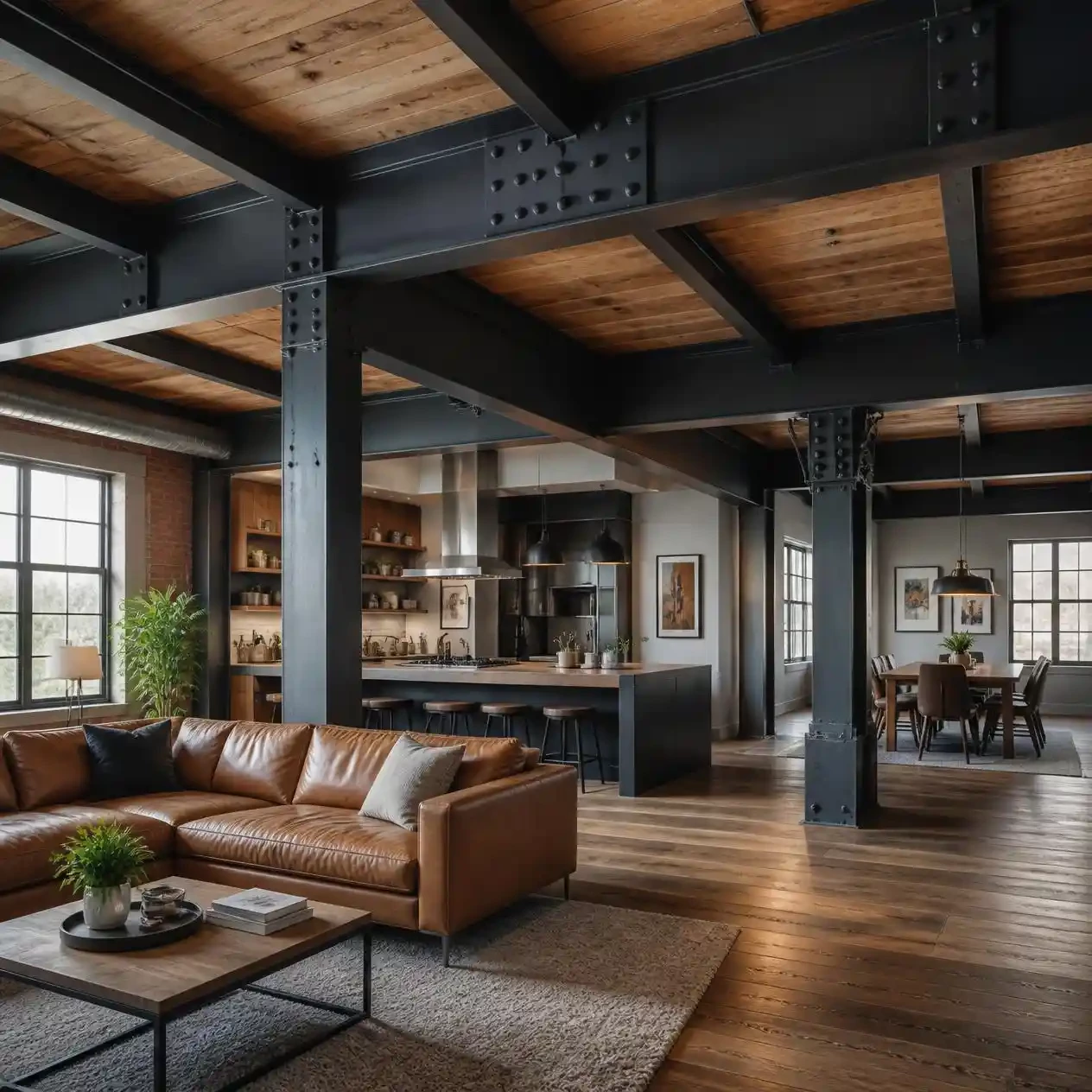
Faux Steel Ceiling Beams (I-Beam Style): H-shaped or I-beam profile beams designed to replicate a welded structural beam running across a ceiling, commonly used in loft, industrial, and modern interiors. Explore Tilton's Industrial Series faux steel beams for the full range of profiles and finishes.
Faux Metal Wall Panels: flat or textured panels finished in a steel or iron appearance, used to cover a wall section or accent area rather than span a ceiling. See Tilton's faux steel and concrete wall panels for panel-specific options, and the broader Decorative Wall Panels guide for how faux steel fits alongside other panel materials.
Faux Concrete Panels: often paired with faux steel panels in the same industrial design family, replicating poured or textured concrete rather than metal specifically.
Decorative Hardware, Rivets, Bolts, and Straps: standalone accent pieces (faux rivets, faux bolt heads, decorative beam straps and brackets) used to detail the joints of a faux steel beam or add authenticity to a plain panel installation. Browse the Accessories category for hardware sold on its own.
Faux Steel vs. Real Steel
The same faux-vs-real trade-off applies here as with faux wood vs. real wood beams, weight, cost, and maintenance favor the faux option in almost every residential and light-commercial scenario:
|
Factor |
Faux Steel (HDU Foam) |
Real Steel |
|
Weight |
Lightweight, several lbs per linear foot |
Very heavy, requires structural engineering |
|
Structural capability |
Non-structural, decorative only |
Can be genuinely load-bearing |
|
Installation |
Mounts to blocking, manageable without heavy equipment |
Requires welding, cranes, or professional structural installation |
|
Cost |
Significantly lower material and labor cost |
High material and installation cost |
|
Rust/patina appearance |
Molded and finished to appear aged |
Develops naturally, or requires intentional treatment |
|
Maintenance |
Low, finish is baked in, won't actually rust or corrode |
Real steel can rust, require sealing or repainting |
|
Best for |
Decorative industrial-style interiors, renovations |
New construction requiring genuine structural steel |
How to Choose the Right Faux Steel Product
- Purpose: Are you framing a ceiling (beams), covering a wall (panels), or detailing an existing structure (hardware only)?
- Room style: Full industrial loft aesthetics suit beams and panels together; a lighter touch might use hardware accents alone on existing wood beams.
- Ceiling height and beam spacing: Similar considerations to faux wood beams, confirm adequate height and plan spacing before ordering.
- Finish intensity: Heavier rust/patina finishes read as more weathered and industrial; cleaner steel finishes suit modern rather than reclaimed-warehouse styles.
- Budget: Beams and panels together cost more than hardware alone — if budget is tight, decorative straps and rivets on existing wood beams can approximate the look at a fraction of the cost.
Best Rooms and Spaces for Faux Steel
Faux steel beams and panels suit lofts, converted industrial spaces, modern kitchens, home offices, and basements aiming for a warehouse-conversion look. They're also common in commercial spaces, restaurants, breweries, retail, where the industrial aesthetic reinforces a brand identity. They tend to feel out of place in traditionally formal or classically decorated rooms, where faux wood beams are a better stylistic match.
Faux Steel Design Ideas
- Full exposed-beam ceiling in faux steel I-beam profile for a genuine warehouse-conversion look
- Mixed material ceilings, faux steel beams paired with faux wood planks from the Faux Beams Buying Guide for an industrial-meets-warmth aesthetic
- Accent wall in faux steel or faux concrete panels, rather than a full room treatment, for broader wall panel style options, see the Decorative Wall Panels guide.
- Hardware-only detailing, decorative straps and rivets added to existing wood beams from the Molded or Artisan Series for a lighter industrial touch without a full material swap
Installation Considerations
Faux steel beams install similarly to faux wood beams, mounting to blocking secured to the ceiling structure, with the hollow beam shell concealing the hardware once in place. Faux metal wall panels typically mount flat against the wall surface with adhesive or a mounting track, depending on the product. Decorative hardware pieces (rivets, bolts, straps) are generally the simplest installation step, often just adhered or screwed into place at the seams once the main beam or panel is installed. Full installation resources are available through the Installation Products category.
Maintenance and Durability
Faux steel products require minimal maintenance, the rust, patina, and weld-seam texture is part of the manufactured finish, not an actual metal surface, so it won't develop new corrosion or require repainting over time the way real steel might. Occasional dusting is typically all that's needed to keep the finish looking as intended.
Common Mistakes to Avoid
Skipping the hardware. A faux steel beam without any rivet or bolt detailing at the joints can read as noticeably less authentic, the hardware is what sells the illusion.
Mismatching finish intensity across a room. Pairing a heavily weathered, rust-finished beam with a clean, minimal panel finish can look inconsistent rather than intentional.
Underestimating scale. Industrial-style beams and panels tend to work best at real structural scale, undersized faux steel elements can read as decorative in a way that undercuts the intended look.
Ignoring room style fit. Faux steel in a traditionally formal room can clash rather than complement, confirm the style direction before committing.
Is Faux Steel Worth It?
For the right room and design direction, yes, faux steel beams and panels deliver a convincing industrial look at a fraction of the weight, cost, and installation complexity of real structural steel, and the decorative hardware options make it possible to add authentic detailing without a full material commitment. It's less worth it in traditionally styled spaces where the aesthetic doesn't fit, or where a lighter design touch (a few hardware accents on existing wood beams) achieves the desired effect more affordably than a full beam-and-panel installation.
Conclusion
Faux steel beams, wall panels, and decorative hardware offer a genuine way to bring an industrial, warehouse-conversion aesthetic into a space without the weight, cost, or structural demands of real steel. The right combination depends on scope, a full beam-and-panel installation for a complete industrial ceiling, or hardware accents alone for a lighter touch on an existing structure. As with any faux material choice, the detail that makes the biggest difference isn't the main beam or panel itself, but the rivet, bolt, and strap hardware that completes the illusion at every joint.
Ready to see the finish and texture in person? Order a sample, shipping is free, and the cost is credited toward your first order.
FAQs
What are faux steel beams made from?
Faux steel beams are typically molded from high-density urethane (HDU) foam, finished with texture and coloring to replicate welded iron or steel, including rust and patina detailing.
Do faux steel beams and panels support real weight?
No, like faux wood beams, faux steel products are decorative and non-structural. They're built to add visual character, not to bear load.
Do the rivets and bolts look real?
Well-made decorative rivets and bolt-head accents are cast with realistic detail and, once mounted at beam joints or panel seams, are difficult to distinguish from genuine hardware at normal viewing distance.
Can faux steel beams be mixed with faux wood beams?
Yes, mixed-material ceilings combining faux steel beams with faux wood planks or beams are a common way to soften a full industrial look with warmth.
Are faux steel panels different from faux concrete panels?
Yes, faux steel panels replicate a metal surface with weld-seam and rust texture, while faux concrete panels replicate a poured or textured concrete look. Both are common in the same industrial design family but read differently.
How is faux steel installed?
Faux steel beams mount to blocking secured to the ceiling structure, similar to faux wood beams; wall panels typically mount flat with adhesive or a mounting track, and hardware accents are generally the simplest step, often just adhered or screwed on at the seams.
Is faux steel a good fit for a traditional-style home?
Generally no, faux steel's industrial character suits lofts, modern, and industrial-style interiors far more than traditionally formal or classic decor, where faux wood beams are usually the better match.
-800x800.png "Custom Fit Shallow Beam")
-800x800.png "Faux Wood Ceiling Beams")
-800x800.png "Ceiling Trusses")