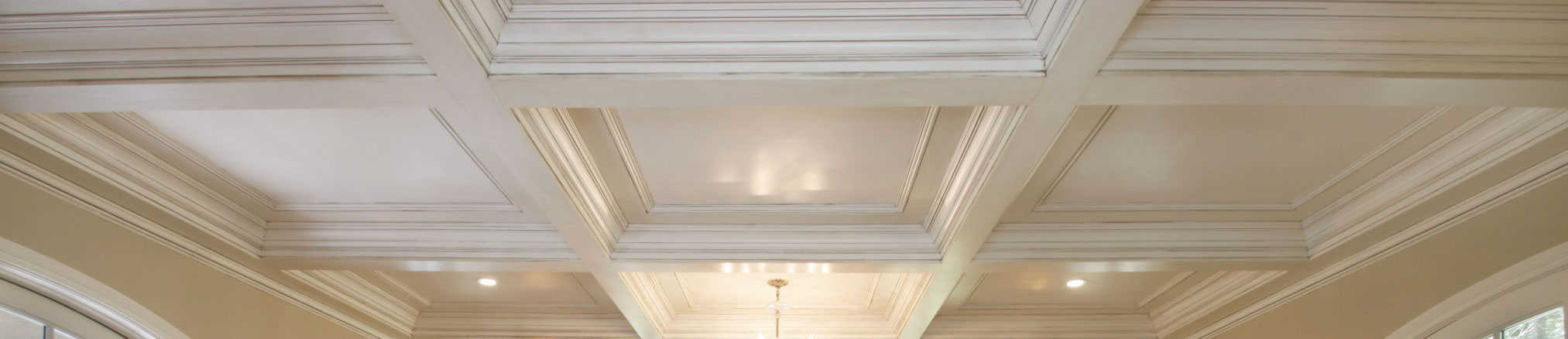



Coffered & Wood Beam Ceilings for Commercial Spaces
Introduction
A flat, featureless ceiling is one of the most common missed opportunities in commercial interior design, restaurants, offices, and retail spaces spend heavily on floors, walls, and fixtures while the ceiling goes untouched. Coffered ceilings and faux wood or steel beam treatments, long associated with high-end residential design, are increasingly showing up in commercial spaces for exactly this reason: they add architectural character and brand-appropriate warmth or industrial edge without the weight, cost, or installation disruption of real structural materials. This guide covers how coffered ceilings and wood beam ceilings work in commercial settings, what to expect on cost and installation, and how to choose the right approach for a restaurant, office, or retail environment.
Quick Answer / Key Takeaway
Coffered ceilings and faux wood or steel beam ceilings work well in commercial spaces because they're lightweight, non-structural, and install with minimal disruption compared to real timber or steel, a genuine advantage for a business trying to minimize downtime during a renovation. The right choice depends on the space's brand identity (warm and traditional vs. industrial and modern), ceiling height, budget, and whether the project is new construction or a retrofit into an existing commercial ceiling.
Table of Contents
- Why Commercial Spaces Use Coffered and Beam Ceilings
- Coffered Ceiling Systems for Commercial Installation
- Faux Wood and Steel Beams in Commercial Settings
- Considerations for Restaurants
- Considerations for Offices
- Considerations for Retail
- Cost and Contractor Considerations
- Installation in an Existing Commercial Space
- Common Mistakes
- Is It Worth It for a Commercial Project?
- FAQ
Why Commercial Spaces Use Coffered and Beam Ceilings
Commercial interior design increasingly treats the ceiling as a design surface rather than an afterthought, a coffered grid or exposed beam ceiling gives a restaurant, office lobby, or retail floor a sense of architectural intention that a flat drywall or standard drop-tile ceiling can't provide. For businesses specifically, the appeal goes beyond aesthetics: faux wood and steel beam systems are lightweight and non-structural, meaning they can be added to an existing commercial space without the structural engineering, cost, and prolonged closure a real timber or steel installation would require.
Coffered Ceiling Systems for Commercial Installation
For the full definition and history of this style, see What Is a Wood Coffered Ceiling?, the same fundamentals apply at commercial scale. A prefab coffered ceiling system, a pre-built grid of beams and panels designed to install as a unit rather than being built up on-site piece by piece, is often the more practical route for a commercial project, where minimizing installation time directly reduces business disruption. These systems are built from the same lightweight materials as residential coffered ceilings, scaled and specified for the larger spans and ceiling heights common in commercial construction. Tilton's Trusses and Box Beam Systems lines are commonly specified for exactly this kind of larger-span commercial layout.
Faux Wood and Steel Beams in Commercial Settings
Beyond a full coffered grid, standalone faux wood beams or faux steel beams are commonly used to add a single architectural statement, a row of beams across a restaurant dining room, or an industrial-style faux steel beam ceiling in a modern office or retail space. See the Faux Beams Buying Guide and the Faux Steel Beams, Panels & Hardware guide for the full material and style breakdown, the same products used residentially apply directly to commercial installations, typically at larger scale.
Considerations for Restaurants
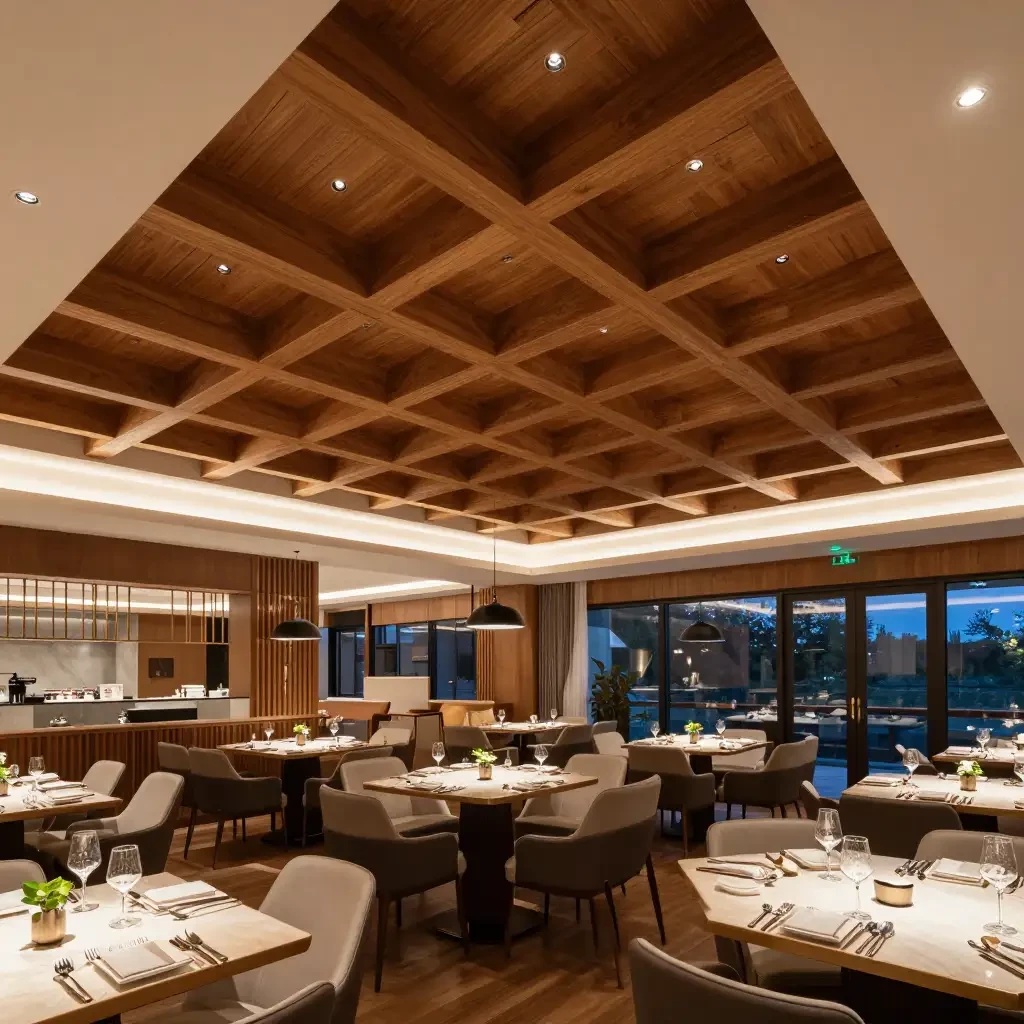
Restaurant ceilings face real practical demands beyond appearance: grease, moisture, cleaning frequency, and the need for a finish that still looks intentional under both daytime and evening lighting. Faux wood beams and coffered ceiling systems hold up well here specifically because the material, HDU foam or similar, doesn't absorb moisture or warp the way real wood might in a kitchen-adjacent dining room, and the finish doesn't require the ongoing refinishing real timber would in a high-turnover commercial environment. A dedicated look at faux beams in hospitality settings is planned as a companion piece to this guide, covering restaurant-specific layouts in more depth.
Considerations for Offices
Office ceilings balance brand identity with practical daily use, a warm wood beam ceiling in a reception or lobby area signals a different brand feel than an exposed faux steel beam treatment in a modern tech office. Beyond aesthetics, offices generally value straightforward installation that doesn't disrupt a working environment, which is where prefab coffered systems and lightweight faux beams have a real practical edge over structural alternatives. This ties closely to the office-specific design guidance planned as part of the broader commercial content cluster alongside this piece.
Considerations for Retail
In retail, ceiling design supports the broader visual merchandising strategy, a coffered or beamed ceiling can frame a specific display area or reinforce a brand's positioning (a beamed ceiling reads differently for a rustic home goods retailer than a sleek faux steel treatment would for a modern electronics store). Ceiling height and lighting integration matter more here than in most other commercial applications, since retail lighting design is often built around the ceiling plane directly. Wall treatments matter just as much in retail, see the Decorative Wall Panels guide for how ceiling and wall materials are commonly paired in a retail interior.
Cost and Contractor Considerations
Commercial coffered and beam ceiling costs vary significantly based on square footage, material choice, and installation complexity, there's no single number that applies across a small café and a large retail floor. What's consistent is that faux wood and steel systems generally cost less in both material and labor than real timber or structural steel equivalents, largely because installation doesn't require the same structural reinforcement or specialized crews. When evaluating a coffered ceiling contractor for a commercial project, confirm experience specifically with commercial-scale installation, not just residential work, spans, code requirements, and installation logistics differ at commercial scale. Tilton's Installation Products and Accessories categories cover the mounting hardware a commercial contractor will need on-site.
Installation in an Existing Commercial Space
Retrofitting a coffered or beam ceiling into an existing commercial space, rather than specifying it during new construction, is where the lightweight, non-structural nature of faux wood and steel products matters most. Installation typically involves mounting blocking to the existing ceiling structure and fitting the beam or panel system over it, a process that can often be scheduled around business hours or during a limited closure window rather than requiring an extended shutdown.
Common Mistakes
Choosing a residential-scale product for a commercial span. Solution: confirm the beam or coffered system is rated and designed for the actual ceiling dimensions and spans involved, commercial spaces often require larger, more robust product specifications than standard residential lines.
Overlooking lighting integration. Solution: plan lighting fixture placement alongside the beam or coffer layout from the start, not as an afterthought once the ceiling design is finalized.
Underestimating installation logistics for an occupied business. Solution: discuss scheduling and disruption minimization directly with the contractor before committing, especially for restaurants and retail spaces that can't easily close for extended periods.
Ignoring brand fit. Solution: match the beam material and finish (warm wood vs. industrial faux steel) to the business's actual brand identity rather than choosing based on personal preference alone.
Is It Worth It for a Commercial Project?
For businesses looking to create a distinctive, higher-end interior impression without a full structural renovation, yes, coffered and beam ceilings offer a meaningful visual upgrade at a cost and installation complexity well below real timber or steel alternatives. They're most worth it in customer-facing spaces (restaurants, retail, office lobbies) where the ceiling is part of the brand experience, and less critical in purely functional back-of-house or utility areas where the investment wouldn't be seen or valued by customers.
Comparison Table
|
Approach |
Best For |
Installation Disruption |
Relative Cost |
Key Consideration |
|
Prefab coffered ceiling system |
Full statement ceiling, new construction or major renovation |
Moderate, pre-built grid installs faster than built-up |
Mid to higher |
Best visual impact, needs adequate ceiling height |
|
Standalone faux wood beams |
Restaurants, offices wanting warmth without a full grid |
Low, can often work around business hours |
Lower to mid |
Matches residential product lines directly |
|
Faux steel beams |
Modern/industrial offices, retail |
Low to moderate |
Mid |
Strong brand-fit tool for industrial positioning |
|
Real timber/structural steel |
New construction wanting genuine structural material |
High, extended closure likely |
Highest |
Rarely justified for retrofit; best for ground-up builds |
Conclusion
Coffered ceilings and faux wood or steel beam treatments give commercial spaces, restaurants, offices, and retail alike, a way to add real architectural character to an otherwise overlooked surface, without the cost, weight, or installation disruption of genuine structural materials. The right approach depends on the business's brand identity, the space's ceiling height and layout, and how much installation disruption the business can accommodate. As with any commercial renovation decision, working with a contractor experienced at commercial scale, not just residential, is what separates a smooth installation from a costly one.
Ready to see the material in person before committing to a commercial project? Order a sample, shipping is free, and the cost is credited toward your first order.
FAQs
Do coffered ceilings work in commercial spaces?
Yes, lightweight faux wood or steel coffered systems are commonly used in restaurants, offices, and retail spaces specifically because they add architectural character without the structural demands of real timber.
How much does a commercial coffered ceiling cost?
Cost varies significantly by square footage, material, and installation complexity, there's no single figure across a small café versus a large retail floor. Faux wood and steel systems generally cost less than real timber or structural steel equivalents.
Can a coffered ceiling be installed without closing a business?
Often, yes, lightweight faux systems can frequently be installed around business hours or during a limited closure window, unlike real structural material installations.
What's the difference between a residential and commercial coffered ceiling contractor?
Commercial installations typically involve larger spans, different code requirements, and more complex installation logistics, confirm a contractor has specific commercial-scale experience, not just residential work.
Are faux wood beams durable enough for a restaurant?
Yes, HDU foam and similar faux wood materials resist moisture and don't warp the way real wood can in a kitchen-adjacent dining environment, making them a practical choice for restaurant use.
Should an office choose wood beams or faux steel beams?
It depends on brand identity, warm wood beams suit a traditional or hospitality-adjacent brand feel, while faux steel beams suit a modern or tech-forward office positioning.
-800x800.png "Custom Fit Shallow Beam")
-800x800.png "Faux Wood Ceiling Beams")
-800x800.png "Ceiling Trusses")