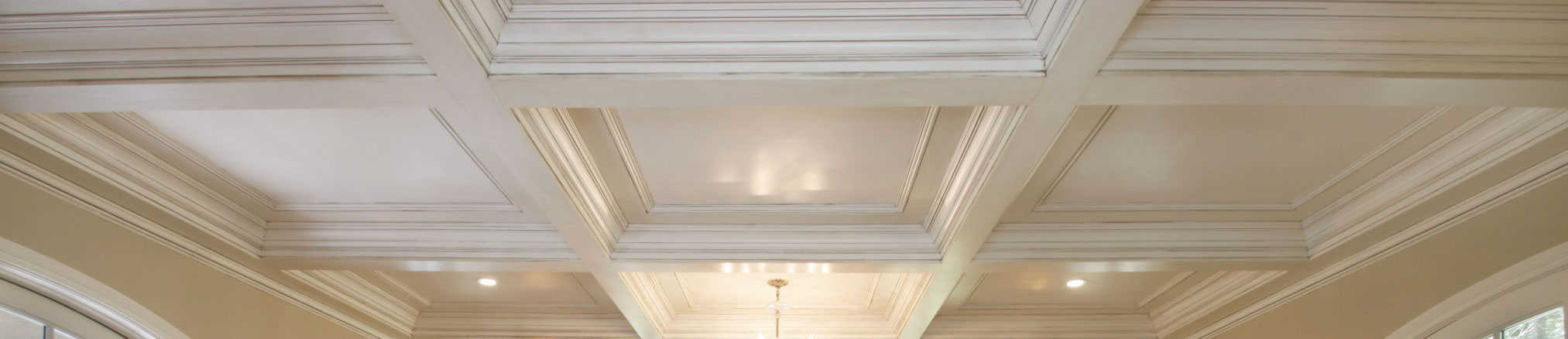



Artisan Series Faux Wood Beams: Hand-Hewn Texture Explained
Not every faux wood beam is trying to look the same way. Some are built for a clean, uniform wood-look finish; others are specifically detailed to replicate the irregular, tool-marked surface of timber shaped by hand rather than a saw. Artisan Series faux wood beams fall into the second category, designed around a hand-hewn texture that reads as older, more rustic, and more visually authentic than a smooth or uniform beam profile. This guide explains what that texture actually is, how it compares to Tilton's other beam lines, and where it works best.
Quick Answer: What Makes Artisan Series Faux Wood Beams Different?
Artisan Series faux wood beams are distinguished by a hand-hewn surface texture, irregular tool-mark detailing cast to replicate the look of timber shaped by hand rather than milled smooth, combined with a more consistent beam thickness than Tilton's Molded Series. They suit rustic, farmhouse, traditional, and lodge-style interiors particularly well, and work across standard and vaulted ceilings alike. The main buying consideration is texture intensity: hand-hewn detailing reads as more visually assertive than a smooth finish, so it's worth confirming it matches your room's overall design language before ordering.
Content Outline
- What Are Artisan Series Faux Wood Beams?
- What Does Hand-Hewn Texture Look Like?
- Key Features
- How Realistic Are Hand-Hewn Faux Beams?
- Pricing Factors
- Choosing the Right Size
- Best Uses (by room)
- Vaulted Ceilings
- Design Styles
- Artisan Series vs. Real Wood
- Installation
- Maintenance
- Common Mistakes
- Is It Worth It?
- FAQ
What Are Artisan Series Faux Wood Beams?
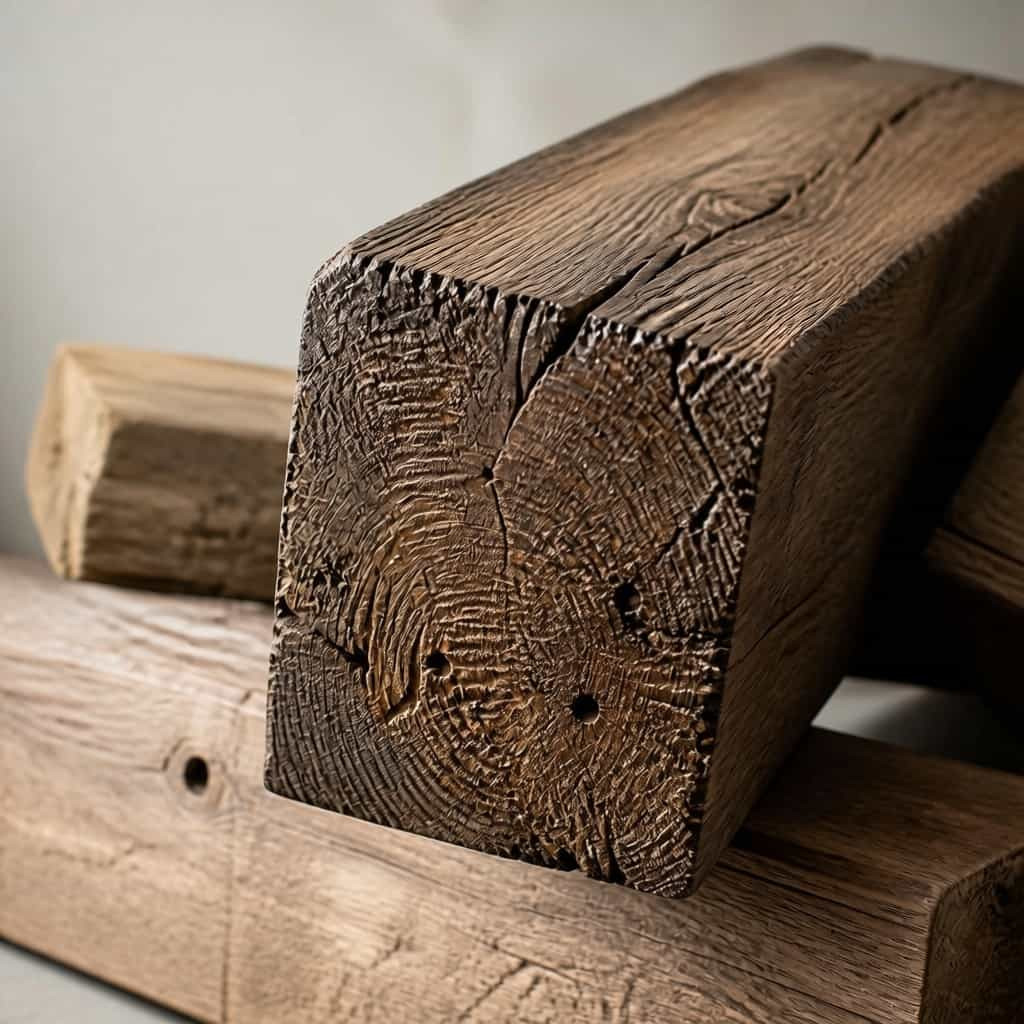
Artisan Series faux wood beams are hollow, decorative beams, like all of Tilton's faux wood lines, cast from real wood to capture authentic grain, distinguished specifically by hand-hewn surface detailing and a consistent 1-inch profile thickness. "Hand-hewn" historically refers to timber shaped with an axe rather than milled smooth by a saw, a technique used for centuries before sawmills became standard in timber framing. Faux wood beams with hand-hewn texture replicate that irregular, tool-marked surface appearance without requiring an actual axe-shaped timber, the texture is cast into the material during manufacturing, giving the finished beam the visual character of hand tooling.
What Does Hand-Hewn Texture Look Like?
Genuine hand-hewn timber has a surface defined by irregular, slightly uneven planes left by an axe, visible tool marks, subtle ridges, and a texture that catches light and shadow differently than a flat-milled surface. Faux hand-hewn beams replicate this visual character: irregular surface variation, a slightly rough or textured finish, and wood grain detailing that reads as aged and authentic rather than uniform. It's worth being precise here: the beam itself isn't actually hewn by hand, the appearance is cast into the material, but the visual result is built specifically to replicate that historical technique's look, distinct from the smoother, more uniform surface of a standard molded beam.
Key Features to Consider
- Hand-hewn surface texture: irregular, tool-marked detailing distinct from a smooth finish
- Consistent 1-inch thickness: a defining construction difference from Tilton's Molded Series, which has variable profile thickness
- Realistic wood grain: cast from real wood, carrying the same authenticity principle as Tilton's other faux wood lines
- Rustic architectural character: built specifically to suit design styles that call for visible texture and age, not a clean modern line
- Decorative, non-structural application: like all faux wood beams, built for visual character, not load-bearing use
How Realistic Are Hand-Hewn Faux Beams?
Well-made hand-hewn faux beams read as convincingly textured and aged at normal viewing distance, since the irregular surface detailing and wood grain are cast from real reference material rather than sculpted generically. That said, it's worth avoiding the claim that any faux material is "indistinguishable" from real hand-hewn timber under close inspection, the honest framing is that the texture is specifically built to replicate the visual character of hand tooling, and does so convincingly at the distance a ceiling is normally viewed from, which is the range that actually matters for most interior applications.
How Much Do Hand-Hewn Faux Wood Beams Cost?
As with any faux wood beam purchase, pricing depends on several factors rather than a single flat rate: beam length, profile size, total quantity, and any finish customization, plus installation labor as a separate cost layer. It's worth distinguishing:
Product cost: scales with beam size and quantity.
Installation cost: labor for mounting, which varies by project complexity.
Total project cost: the combined figure that actually determines budget fit.
Because the hand-hewn texture and thickness differ from Molded Series construction, it's worth requesting a specific quote for Artisan Series rather than assuming Molded Series pricing applies directly, the two lines aren't interchangeable on cost any more than they are on appearance.
Choosing the Right Size
Beam sizing for Artisan Series follows the same core logic as any faux wood beam: ceiling height, room scale, and intended spacing all factor in. Because Artisan beams carry a consistent 1-inch thickness rather than the variable profile of Molded Series, the visual weight per beam reads slightly differently, worth keeping in mind when comparing the two lines side by side for the same room. As always, measuring actual ceiling height and room width before finalizing an order is more reliable than estimating from a photo reference.
Best Uses for Artisan Series Faux Wood Beams
Living Rooms: hand-hewn texture reads especially well as a defined grid over a main seating area in a room with rustic or traditional styling.
Great Rooms: larger open spaces can carry the more visually assertive hand-hewn texture at scale without it overwhelming the room.
Kitchens: particularly farmhouse-style kitchens, where the textured finish reinforces the overall design language.
Dining Rooms: a natural fit for traditional or lodge-style dining spaces wanting a more historic feel.
Entryways: a shorter run at an entry sets a rustic tone immediately, often paired with a matching faux wood mantel nearby.
Bedrooms: typically a lighter touch than a full living room grid.
Vaulted and high ceilings: see the dedicated section below.
Faux Wood Beams for Vaulted Ceilings
Vaulted ceilings are one of the strongest applications for hand-hewn faux beams specifically, since the added height gives the more visually assertive texture room to read as substantial rather than busy. Beam placement typically follows the roofline, with spacing planned around room width and the vault's actual pitch, geometry that varies enough from home to home that it's worth planning against your specific ceiling rather than a generic template. For the fuller buying context across Tilton's beam lines, see the Faux Beams Buying Guide.
Design Styles That Work With Hand-Hewn Faux Beams
- Rustic: the most natural fit; hand-hewn texture is practically built for this style
- Farmhouse and modern farmhouse: texture adds authenticity against otherwise clean, neutral interiors
- Mountain/lodge: pairs especially well with decorative trusses for a fuller rustic ceiling treatment
- Traditional: darker stains and tighter spacing lean formal without losing the textured character
- Transitional: a lighter stain can soften the texture for a less overtly rustic look
Artisan Series Faux Wood Beams vs. Real Wood Beams
|
Factor |
Artisan Series Faux Wood Beams |
Real Wood Beams |
|
Appearance |
Hand-hewn texture cast from real wood reference |
Authentic, naturally variable grain and age |
|
Texture |
Consistent, engineered hand-hewn detailing |
Genuinely irregular, unique to each piece |
|
Weight |
Lightweight, hollow construction |
Significantly heavier, solid material |
|
Installation |
Mounts over blocking, generally accessible |
Often requires additional structural support |
|
Pricing |
Generally more accessible than solid wood |
Typically higher material and installation cost |
|
Maintenance |
Low, resists warping, cracking, pests |
Higher, may need periodic sealing/refinishing |
|
Structural use |
Non-structural, decorative only |
Can occasionally be genuinely structural |
|
Best applications |
Rustic/farmhouse styling on a controlled budget |
Projects prioritizing fully authentic material |
For a deeper look at this trade-off across all of Tilton's beam lines, see Faux Wood vs. Real Wood: Which Is Right for You?
Installation Considerations
- Measure the room and ceiling
- Determine beam layout and spacing
- Select beam proportions appropriate to the room
- Check mounting/blocking requirements, see Installation Products and Accessories
- Plan joints and transitions where beams meet walls or each other
- Prepare the installation area
- Follow manufacturer installation instructions
- Check final alignment before considering the project complete
Maintenance and Long-Term Care
Artisan Series beams require minimal ongoing maintenance, occasional dusting is typically sufficient, since the hand-hewn texture is part of the manufactured finish rather than an actual weathered surface that continues to age. It's still worth periodically inspecting visible joints and following any finish-specific manufacturer care guidance.
Common Mistakes When Choosing Faux Wood Beams
Choosing hand-hewn texture for a design style it doesn't suit.
Solution: confirm the room's overall style calls for visible texture before committing, a clean modern interior may be better served by a smoother finish.
Ignoring the thickness difference from Molded Series.
Solution: don't assume the two lines are interchangeable on visual weight or pricing, request Artisan-specific guidance.
Choosing beam size disconnected from room proportions.
Solution: measure ceiling height and room scale directly rather than estimating from inspiration photos.
Treating decorative beams as structural.
Solution: understand upfront that Artisan Series beams are non-structural.
Focusing only on beam price rather than total project cost.
Solution: budget for installation labor alongside the product cost from the start.
Are Artisan Series Faux Wood Beams Worth It?
For homeowners specifically wanting a rustic, textured, hand-hewn look, not just generic wood-look beams, Artisan Series is a strong choice, offering that specific aesthetic without the cost or scarcity of genuinely reclaimed or hand-hewn timber. It's a weaker fit for modern or minimalist interiors where a smoother finish would suit the room better, or for projects requiring authentic natural material regardless of cost. As with any beam decision, matching the texture intensity to your room's actual design language matters more than defaulting to whichever line sounds most premium.
FAQs
What are Artisan Series faux wood beams?
Artisan Series faux wood beams are hollow, decorative beams built with a hand-hewn surface texture and a consistent 1-inch thickness, cast from real wood to replicate authentic grain and an aged, hand-tooled appearance.
What does hand-hewn texture mean?
Hand-hewn refers to timber historically shaped with an axe rather than milled smooth by a saw. Faux hand-hewn beams replicate that irregular, tool-marked visual character without requiring an actual axe-shaped timber.
Are hand-hewn faux wood beams realistic?
Yes, at normal viewing distance, the texture and grain are cast from real reference material, though it's fair to note the beam itself isn't actually hand-hewn, only visually designed to replicate that look.
How much do faux wood beams cost?
Cost depends on beam size, length, quantity, and finish, plus separate installation labor. Artisan Series pricing should be requested specifically rather than assumed to match Molded Series, since the two lines differ in thickness and texture.
What size faux wood beam should I use?
Sizing depends on ceiling height, room scale, and intended spacing, measuring your actual room is more reliable than estimating from inspiration photos.
Can faux wood beams be used on vaulted ceilings?
Yes, vaulted ceilings are one of the strongest applications for hand-hewn beams specifically, since the added height lets the more visually assertive texture read as substantial rather than busy.
Are faux wood beams structural?
No, Artisan Series beams, like all faux wood beams, are decorative only and not designed to bear structural load.
Are Artisan Series faux wood beams worth it?
For rustic, farmhouse, or lodge-style interiors specifically wanting a textured, hand-hewn look, yes. Modern or minimalist rooms are usually better served by a smoother beam finish.
-800x800.png "Custom Fit Shallow Beam")
-800x800.png "Faux Wood Ceiling Beams")
-800x800.png "Ceiling Trusses")