


Decorative Ceiling Trusses: A Complete Style Guide
A flat ceiling can make even a well-designed room feel unfinished, especially once the walls, floors, and furniture are doing their job and the ceiling is the one surface with nothing going on. Decorative ceiling trusses are one of the most direct ways to fix that: they add structure, rhythm, and visual depth overhead without touching the room's actual architecture. This guide walks through what decorative ceiling trusses are, how they differ from the structural trusses that hold a roof up, the styles available, how they compare with decorative ceiling beams and ceiling panels, and how to plan a layout that actually fits your space. If you're comparing this style against a flatter, gridded look, our guide to what a wood coffered ceiling is covers that broader category in full.
Quick Answer: What Are Decorative Ceiling Trusses?
Decorative ceiling trusses are triangular or angled architectural elements installed on a ceiling purely for visual effect, not to support the roof or floor above. Most are built from lightweight faux wood or genuine timber and mounted directly to the ceiling surface or blocking. They work best on vaulted, cathedral, or open-concept ceilings where there's enough visual space for a strong architectural statement, and they come in rustic, farmhouse, modern, industrial, and traditional timber-frame styles.
What Are Decorative Ceiling Trusses?
A truss, in the structural sense, is a triangulated framework engineered to carry load across a span, the kind of truss holding up a barn roof or a bridge. A decorative ceiling truss borrows that same triangular, timber-frame silhouette but strips away the structural function. It's an architectural feature, not a load-bearing one, unless it's been specifically engineered otherwise by a structural professional.
That distinction matters because decorative trusses and faux wood truss beams are usually the lightest-weight product in a ceiling product line, built from the same hollow faux wood construction used for decorative ceiling beams and trusses, just assembled into a triangular or king-post profile instead of a straight run. The visual payoff is bigger than a single beam: a truss reads as a complete architectural assembly, which is exactly why it tends to anchor a room's ceiling design rather than simply accent it.
Decorative Ceiling Trusses vs. Structural Trusses
This is the single most common point of confusion, so it's worth being direct about it.
|
Decorative Trusses |
Structural Trusses |
|
|
Primary purpose |
Aesthetic, interior design feature |
Engineered to carry roof/floor load |
|
Load-bearing |
No, unless specifically engineered |
Yes, core function |
|
Weight |
Lightweight (faux wood or thin timber) |
Heavy, full-dimension lumber or steel |
|
Installation |
Mounts to ceiling surface or blocking |
Part of building construction, installed during framing |
|
Where it's chosen |
After the room exists, for design |
Before the room exists, for the building |
If you're adding visual trusses to an existing finished ceiling, you're working with a decorative product. If you're opening up a ceiling to expose or modify the actual roof framing, that's a structural question, and one to take to a licensed contractor or structural engineer, not a product page.
Why Use Decorative Ceiling Trusses?
Beyond filling visual space, decorative trusses do a few specific jobs well, and they draw from the same full range of ceiling beams and trusses used to solve these problems elsewhere in a home:
- Create a ceiling focal point: In rooms where the floor plan and furniture are already doing the design work, the ceiling is the one surface left to carry visual interest.
- Define large, open rooms: In open-concept layouts, a truss (or a repeated series of them) can visually separate a living area from a dining area without adding a wall.
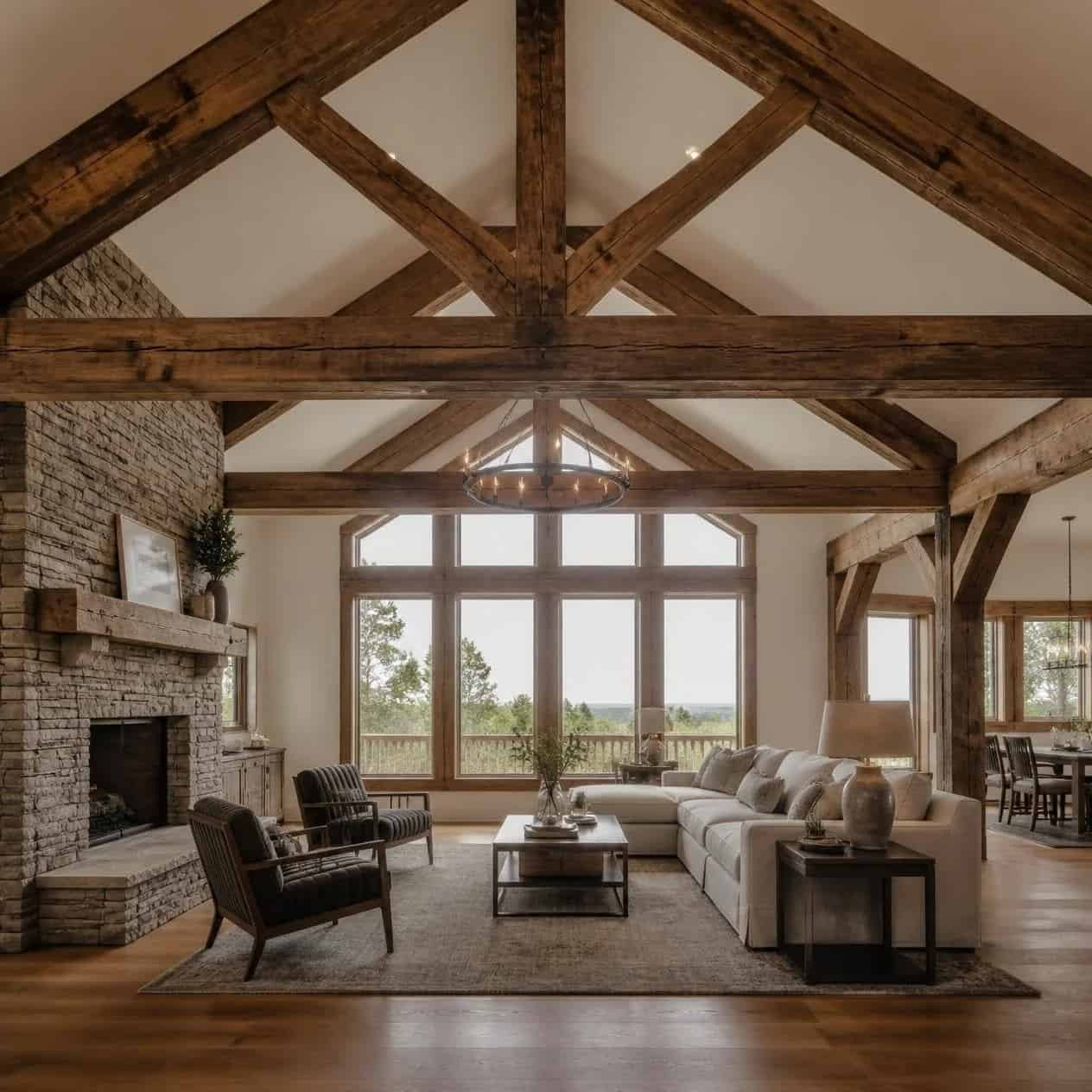
- Enhance vaulted and cathedral ceilings: The added height on these ceilings gives a truss room to read as substantial rather than cramped against a standard 8-9 foot ceiling.
- Set a design direction fast: A single rustic truss over a great room, or a dark industrial-finish truss in a loft, tells a visitor what the room's style is before they notice anything else.
Popular Decorative Ceiling Truss Styles
Before comparing individual looks, it helps to browse the full range of decorative truss styles Tilton carries, since several of these styles share finish and construction details with the beam lines below.
Rustic Trusses
Natural-looking wood character, visible grain, and a slightly irregular surface. Fits farmhouse, mountain-lodge, and traditional rustic interiors, the same character you'll see in the hand-hewn Artisan Series beams, which pairs naturally with a rustic truss in the same room.
Farmhouse Trusses
Similar wood character to rustic styles but typically paired with lighter finishes and cleaner joinery, a softer, more transitional version of the same look, and a style that also shows up in rustic and farmhouse beam styles from the Artisan line.
Modern Trusses
Clean geometry, minimal surface texture, and often a single uniform finish. These work when the room's design is already restrained and the truss needs to read as architecture rather than decoration, the same restraint behind the Artisan Smooth beams finish.
Industrial Trusses
Darker finishes, metal-inspired detailing (straps, bolts, bracket hardware), and strong visual contrast against lighter walls or ceilings. A natural pairing with exposed brick, concrete, or loft-style interiors, and often used alongside Industrial Series faux steel beams and faux metal ceiling tiles for a consistent industrial look.
Traditional Timber-Frame Trusses
Classic king-post or queen-post silhouettes that reference historic barn and hall framing. These lean on the truss form's original structural logic even though the installed product is purely decorative, drawing on the same timber framing tradition.
Faux Wood Trusses
Across every style above, faux wood construction is what makes the look practical: the same visual grain and detail as solid timber framing, built hollow and lightweight so it mounts without the weight or installation demands of real structural timber. The Molded Series faux beams use this same hollow-cast construction method, just in a straight-run beam profile instead of a triangular truss.
Common Decorative Truss Profiles
Beyond design style, trusses are also described by their shape. These are the profiles buyers most often ask about:
- King post: A central vertical post rising to the peak, with two angled members. The most recognizable and symmetrical profile, and a strong fit for a single focal-point truss.
- Queen post: Two vertical posts with a horizontal member between them, which leaves an open center. It suits wider rooms and gives a more spacious look than a king post.
- Arched or curved: Curved lower or upper members soften the geometry. Good for traditional, Mediterranean, and transitional rooms.
- Scissor: Crossing lower members create a steeper interior slope that echoes a vaulted ceiling.
- Flat or horizontal-tie: A straighter, simpler profile that reads cleaner and more modern.
- Ridge beam accents: A single beam along the ceiling peak, often paired with trusses or beams across the room on cathedral ceilings.
Product lines name and size these profiles differently, so confirm the exact profile, dimensions, and finish for any specific product on its product page rather than assuming from the name.
Interior vs. Exterior Use, Wiring, and Lighting
Two practical questions come up before almost every order:
- Interior vs. exterior: Decorative trusses are normally specified for interior ceilings. If you're considering a covered porch, gable, or other outdoor application, confirm that the specific product is rated for exterior exposure before ordering. Don't assume an interior product will hold up outdoors.
- Wiring, ducts, and lighting: Many faux wood trusses and beams use a hollow construction, which can allow wiring for lighting to be routed discreetly. Whether a given product supports this, and how, depends on its design, so check the product details and have any electrical work done by a licensed electrician.
What Affects the Cost of Decorative Ceiling Trusses
Prices vary widely, so this is a framework rather than a number. The main drivers are:
- Material: Faux wood is generally the lighter, more economical route; real timber costs more and adds weight and installation complexity.
- Size and span: Larger trusses use more material and take more planning.
- Profile complexity: Arched, scissor, and multi-member assemblies take more work than a flat or simple king-post profile.
- Finish and detailing: Stain, hand-finished texture, and hardware add cost.
- Quantity and layout: One focal-point truss costs less than a repeated series, but the repeated series often looks more intentional in a long room.
- Installation: Lightweight faux construction can simplify this, but complex layouts may still call for a professional installer.
Order a sample first. Comparing a finish sample against your actual wall color, flooring, and lighting avoids most expensive surprises.
Decorative Ceiling Trusses vs. Decorative Ceiling Beams
Trusses and beams solve a similar problem, adding architectural character to a ceiling, but they're not interchangeable.
|
Factor |
Decorative Trusses |
Decorative Ceiling Beams |
|
Visual weight |
Higher, reads as a full assembly |
Moderate, a single linear element |
|
Best layout |
A focal point or repeated pattern |
A grid or parallel-run pattern |
|
Room fit |
Large, open, or vaulted rooms |
Broad range of room sizes |
|
Design flexibility |
High, but needs visual space |
High, works in tighter rooms too |
|
Faux wood options |
Yes |
Yes, molded faux beams, hand-hewn faux beams, smooth faux beams |
If a room is large enough and the ceiling has enough height, a truss creates more architectural drama. If the room is smaller or the ceiling is standard height, decorative wood beams run in a simpler pattern usually look more proportional.
Faux Wood Trusses vs. Real Wood
Neither material is universally better, the right choice depends on what the project actually needs, a question covered in more depth in our dedicated faux beams vs. real wood beams guide.
- Appearance: Faux wood trusses are molded from real wood masters, so grain and texture are close to authentic. Real wood, our Natural Series real wood beams, offers genuine material variation that faux construction can only replicate.
- Weight: Faux wood is dramatically lighter, which usually means a simpler, one-person-friendly installation. Real wood trusses are heavier and may need additional planning or support.
- Consistency: Faux wood trusses are more consistent from unit to unit. Real wood varies piece to piece, which some buyers want and others don't.
- Maintenance: Faux wood resists warping, cracking, and insects by construction. Real wood requires more long-term care depending on climate and finish.
Choosing the Right Truss Style for Your Ceiling
Ceiling Height
Standard 8-9 foot ceilings rarely have the visual room for a full truss assembly, a single decorative beam usually reads better. Vaulted and cathedral ceilings are where trusses earn their keep.
Room Size
A truss sized for a great room will overwhelm a small den. Proportion between the truss and the room's floor area matters as much as the ceiling height.
Architectural Style
Match the truss to the room that already exists rather than selecting a style in isolation, a modern truss in a heavily traditional room will look like an afterthought, and vice versa.
Desired Visual Weight
A single king-post truss as a centerpiece reads very differently than a repeated series running the length of a room. Decide which effect the room actually needs before picking a style.
Material and Finish
Faux wood for lighter installation and consistent appearance; real timber for material authenticity; faux steel-look finishes for industrial direction.
Budget and Installation
Decorative trusses are generally more complex to plan than a single beam, simply because there's more assembly involved, factor beam and truss installation planning into the decision alongside the product itself.
Best Rooms for Decorative Ceiling Trusses
Living rooms, great rooms, and dining rooms with vaulted or raised ceilings are the strongest fits. Entryways and home offices with double-height ceilings also work well. In commercial settings, restaurants, hospitality interiors, and retail spaces use decorative trusses to establish a design identity, often alongside commercial ceiling panel systems in the surrounding ceiling area.
Decorative Ceiling Trusses for Vaulted and High Ceilings
This is genuinely where decorative trusses perform best, and it tracks with real search demand, "vaulted ceiling trusses," "truss for vaulted ceiling," and "faux beams for vaulted ceiling" all show meaningful search interest. The added vertical space gives a truss room to read as architecture rather than clutter, and it's the one ceiling type where a full truss assembly tends to outperform a simpler decorative ceiling beam layout visually. As with any decorative ceiling product, this doesn't add structural support to the roof itself, it's a visual treatment layered onto an existing, already-sound ceiling.
Decorative Trusses, Ceiling Panels, and Other Ceiling Treatments
Trusses don't have to do all the work alone. Coffered ceiling panels can fill the surrounding ceiling field while a truss anchors the room's focal point. Floating ceiling panels or decorative wall panels extending from the walls can echo a truss's finish for a more unified design, and in commercial spaces, faux metal ceiling tiles can extend an industrial truss's finish across the rest of the ceiling field. The goal in combining these products is cohesion, not stacking every ceiling treatment into one room.
How to Plan a Decorative Ceiling Truss Layout
Once a style and room are settled, the ceiling beam and truss collection gives a sense of real dimensions to plan around. From there:
- Measure the room's length, width, and ceiling height.
- Identify the ceiling's highest and lowest points, especially on vaulted or sloped designs.
- Decide where the visual focal point should sit, centered, or aligned with a specific architectural feature.
- Consider truss direction relative to the room's longest sightline.
- Establish spacing if using more than one truss.
- Align placement with existing architectural features (windows, fireplaces, structural beams).
- Account for lighting fixtures and their placement relative to the truss.
- Note HVAC vents, ceiling fans, or sprinklers that may affect placement.
- Balance visual weight so the truss doesn't overwhelm or underwhelm the room.
- Review the full layout before ordering or installing.
This is a design-planning sequence, not a structural one, any ceiling modification beyond surface-mounted decorative products should go through a qualified contractor.
Common Decorative Ceiling Truss Design Mistakes
- Oversizing for the room: A truss scaled for a great room will dominate a smaller space.
- Ignoring ceiling height: Standard-height ceilings rarely have room for a full truss assembly.
- Overloading the ceiling with visual elements: Combining a truss with heavy beams and ceiling panels in the same small area can read as cluttered rather than architectural.
- Mixing incompatible styles: A rustic truss next to clean modern trim fights itself visually.
- Confusing decorative and structural products: Treating a decorative truss as load-bearing, or assuming structural work is needed when it isn't.
- Clashing finishes: A finish that doesn't match the room's existing wood tones or decorative beam brackets and hardware undercuts the whole effect.
Decorative Ceiling Trusses for Residential vs. Commercial Spaces
Residential applications lean toward great rooms, living rooms, kitchens with vaulted ceilings, and farmhouse or modern homes where the truss reinforces an already-established interior style.
Commercial applications, restaurants, hospitality spaces, offices, and retail, use decorative trusses to build a brand identity fast, often paired with commercial coffered ceilings and commercial ceiling panels across the surrounding ceiling field for a complete architectural statement.
How to Choose Between Trusses, Beams, and Ceiling Panels
Choose decorative trusses when: you want a strong architectural focal point, the ceiling has the height and floor area to support it, and you want a timber-frame-inspired look.
Choose decorative beams when: you want simpler linear accents, the room is smaller or has standard ceiling height, or you want to define zones without a full truss pattern, see the full beam and truss collection for the range available.
Choose ceiling panels when: you want broader ceiling coverage with texture or pattern, or you're designing a commercial or contemporary space where the whole ceiling field (not just a focal point) needs treatment, browse ceiling and wall paneling options to compare.
Final Thoughts
Decorative ceiling trusses are one of the highest-impact ways to give an otherwise flat ceiling real architectural character, but they work best when the room's proportions, ceiling height, and existing style all support the decision. Get the sizing and placement right, and a truss can carry a room's entire design direction on its own. For a broader look at how beams, trusses, and panels fit together as a single design system, our coffered ceiling design guide is the best next read, and you can explore the full ceiling beam and truss collection whenever you're ready to compare options directly.
FAQ
What are decorative ceiling trusses?
Decorative ceiling trusses are triangular or angled architectural elements installed on a ceiling for visual design rather than structural support, typically built from lightweight faux wood or real timber.
Are decorative ceiling trusses structural?
No. Decorative trusses are non-structural unless specifically engineered otherwise, they're a visual treatment added to an already-sound ceiling, not part of the building's load-bearing framework.
What is the difference between ceiling beams and decorative trusses?
Beams are single linear accents that work in a broad range of rooms; trusses are full triangular assemblies that create a stronger focal point and generally need more ceiling height and floor area to look proportional.
Can decorative ceiling trusses be used on vaulted ceilings?
Yes, vaulted and cathedral ceilings are where decorative trusses perform best, since the extra height gives the assembly room to read as architecture rather than clutter.
Are faux wood trusses lighter than real wood?
Yes. Faux wood trusses are hollow and considerably lighter than solid timber, which generally makes installation simpler and more accessible.
Which rooms work best with decorative ceiling trusses?
Great rooms, living rooms, and dining rooms with vaulted or raised ceilings are the strongest residential fits; restaurants, hospitality spaces, and retail interiors are common commercial applications.
Can decorative trusses be used in commercial spaces?
Yes, restaurants, offices, and retail environments frequently use decorative trusses to establish a design identity, often alongside commercial ceiling panels for a complete look.
Can decorative ceiling trusses be used outdoors?
Decorative trusses are normally specified for interior ceilings. For a covered porch, gable, or other outdoor use, confirm that the specific product is rated for exterior exposure before ordering.
What are the most common decorative truss profiles?
King post, queen post, arched or curved, scissor, and flat or horizontal-tie profiles are the most common, and ridge beam accents often accompany them on cathedral ceilings.
What affects the cost of decorative ceiling trusses?
Material (faux wood vs. real timber), size and span, profile complexity, finish and hardware, quantity, and installation are the main drivers. Ordering a sample first helps confirm the finish before committing.
How do I choose the right decorative ceiling truss style?
Start with ceiling height and room size, then match the truss style (rustic, farmhouse, modern, industrial, or traditional timber-frame) to the room's existing architecture rather than choosing a style in isolation.
-800x800.png "Faux Wood Ceiling Beams")
-800x800.png "Ceiling Trusses")
-800x800.webp "Faux Beams for Ceilings: The Complete Buying Guide")